 ChipApex | Global Electronic Components Supplier
SEARCH
Search Product
Search Post
— IC芯片 | 连接器 | 传感器 | 被动器件 —
Search productSearch post
— IC芯片 | 连接器 | 传感器 | 被动器件 —
Consult the customer manager about the wholesale price.
consultation hotline:86-132-6715-2157
email:[email protected]
Contact the product manager for consultation. One-stop consultation is available.
Do you want a lower wholesale price? Please send us your inquiry and we will reply immediately.
The Fairchild Semiconductor 100EL16M is a single-channel differential receiver integrated circuit designed for high-speed interface applications. It operates within a supply voltage range of 4.2V to 5.5V and supports a temperature range of -40°C to 85°C. The device features an internally generated supply voltage source, VBB, which facilitates operation in single-ended input conditions by allowing the unused input to be managed effectively. Packaged in an 8-SOIC format, this component functions as a zero-delay buffer receiver, ensuring signal integrity across digital communication links without introducing propagation delay variations.
Verify the manufacturer part number against official Fairchild or onsemi documentation to ensure authenticity. Confirm that the 8-SOIC package matches the required footprint. Check for any specific ordering suffixes that may indicate tape-and-reel packaging versus tube quantities, though such details should be confirmed via the distributor's current stock listing rather than assumed from the base part number.
Select the 100EL16M when a single-channel differential receiver with internal biasing is required for 5V logic interfaces. Consider its zero-delay characteristic if precise timing alignment between input and output signals is critical. Ensure the operating environment falls within the specified -40°C to 85°C range and that the 4.2V to 5.5V supply voltage aligns with the system design constraints.
The 100EL16M belongs to the 100EL series of receivers manufactured by Fairchild Semiconductor, now part of onsemi. This series is designed for robust performance in digital interface applications requiring differential signal processing. The component serves as a specialized receiver within the broader family of drivers, receivers, and transceivers offered by the manufacturer, targeting high-reliability electronic systems.
The 100EL16MX is listed as a related variant within the same product family, also packaged in 8-SOIC. Verify electrical specifications and pinout compatibility before substitution. No other direct substitute part numbers are publicly confirmed in the provided documentation.
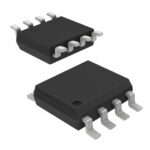 100EL16M
The activity of extra discounts on wholesale prices is in full swing…
Please fill in your contact information and we will send you the latest wholesale price list.






