ChipApex | Global Electronic Components Supplier
SEARCH
Search Product
Search Post
— IC芯片 | 连接器 | 传感器 | 被动器件 —
Search productSearch post
— IC芯片 | 连接器 | 传感器 | 被动器件 —
Consult the customer manager about the wholesale price.
consultation hotline:86-132-6715-2157
email:[email protected]
Contact the product manager for consultation. One-stop consultation is available.
Do you want a lower wholesale price? Please send us your inquiry and we will reply immediately.
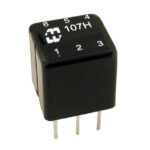
The Hammond Manufacturing 107G is a potted audio transformer designed for professional and consumer audio applications. It features a primary impedance of 600 CT ohms and a secondary impedance of 250 CT ohms, resulting in a turns ratio of 1.52:1. The component utilizes a through-hole termination style with pin terminals and is housed in a compact mini epoxy package. Its frequency response ranges from 300 Hz to 50 kHz, ensuring reliable signal transmission across standard audio bands.
Verify the specific datasheet version provided by Hammond Manufacturing or authorized distributors to confirm exact electrical tolerances and mechanical dimensions. Ensure that the center-tapped configuration aligns with the circuit design requirements. Cross-reference the part number 107G against current manufacturer catalogs to confirm availability and compliance with relevant safety standards before finalizing procurement orders.
Select this component when a 1.52:1 impedance transformation ratio between 600-ohm and 250-ohm lines is required. The through-hole mounting style suits PCB designs where robust physical connection is prioritized. Consider the 300 Hz to 50 kHz frequency range to ensure compatibility with the intended audio bandwidth. Verify that the potted epoxy housing meets the environmental conditions of the installation site.
The 107G belongs to the Hammond Manufacturing 107 series of audio transformers. This series is characterized by miniature epoxy packages suitable for space-constrained designs. The 107G specifically addresses applications requiring precise impedance matching between standard telephony and audio line levels, distinguishing it from higher-power or wideband variants within the broader product family.
Consult official Hammond Manufacturing substitution guides for direct equivalents. Generic replacements must match the 600 CT/250 CT impedance configuration and 1.52:1 ratio. Verify footprint compatibility for through-hole pin terminals. Do not assume interchangeability without confirming electrical parameters and mechanical dimensions against the original specification sheet.

The activity of extra discounts on wholesale prices is in full swing…
Please fill in your contact information and we will send you the latest wholesale price list.