 ChipApex | Global Electronic Components Supplier
SEARCH
Search Product
Search Post
— IC芯片 | 连接器 | 传感器 | 被动器件 —
Search productSearch post
— IC芯片 | 连接器 | 传感器 | 被动器件 —
Consult the customer manager about the wholesale price.
consultation hotline:86-132-6715-2157
email:[email protected]
Contact the product manager for consultation. One-stop consultation is available.
Do you want a lower wholesale price? Please send us your inquiry and we will reply immediately.
The Vishay 10ETF04S is a fast soft recovery rectifier diode rated for 400 V maximum repetitive reverse voltage and 10 A average forward current. It utilizes a D2PAK surface-mount package with a common cathode base. Key electrical characteristics include a maximum forward voltage drop of 1.2 V at 10 A, a reverse recovery time of 50 ns under specified conditions, and a peak non-repetitive surge current capability of 150 A. The device operates within a junction temperature range of -40 °C to 150 °C.
Verify the specific ordering suffix to confirm packaging orientation and lead-free status. The standard production version arrives in tubes, while TRR indicates right-oriented tape and reel, and TRL indicates left-oriented tape and reel. Confirm that the component meets industrial qualification requirements before integration into final designs.
Select this component for high-frequency switching applications where minimizing reverse recovery charge is critical. Ensure the circuit design accommodates the 1.2 V forward voltage drop to manage thermal dissipation effectively. Verify that the 400 V rating provides sufficient margin for the peak inverse voltage present in the target application environment.
This part belongs to the 10ETF..S Soft Recovery Series from Vishay High Power Products. The series includes variants with 200 V (10ETF02S) and 600 V (10ETF06S) ratings, all sharing the same 10 A current rating and D2PAK surface-mount package configuration for consistent mechanical integration across different voltage levels.
Direct substitutes within the same series include the 10ETF02S for 200 V applications and the 10ETF06S for 600 V applications. Ensure any replacement maintains the D2PAK footprint and matches the required reverse voltage rating for the specific circuit topology.
The maximum thermal resistance from junction to case (RthJC) is 1.5 °C/W under DC operation conditions.
The datasheet specifies a reverse recovery time of 50 ns generally, but detailed graphs show variations based on junction temperature (25 °C vs. 150 °C) and the rate of fall of forward current (dI/dt).
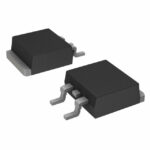 10ETF04S
The activity of extra discounts on wholesale prices is in full swing…
Please fill in your contact information and we will send you the latest wholesale price list.





