 ChipApex | Global Electronic Components Supplier
SEARCH
Search Product
Search Post
— IC芯片 | 连接器 | 传感器 | 被动器件 —
Search productSearch post
— IC芯片 | 连接器 | 传感器 | 被动器件 —
Consult the customer manager about the wholesale price.
consultation hotline:86-132-6715-2157
email:[email protected]
Contact the product manager for consultation. One-stop consultation is available.
Do you want a lower wholesale price? Please send us your inquiry and we will reply immediately.
The Vishay VS-113CNQ100A is a center tap Schottky rectifier module featuring two independent legs with a common cathode configuration. It utilizes the D-61 package and supports a maximum average forward current of 110 A (55 A per leg) and a repetitive peak reverse voltage of 100 V. The device operates within a junction temperature range of -55 °C to +175 °C, offering a typical forward voltage drop of 0.67 V at 55 Apk and 125 °C. It withstands non-repetitive surge currents up to 7000 A and includes guard ring technology for enhanced ruggedness.
Verify the specific package variant required, as the series includes standard leaded (PbF), surface mount (ASM), and low profile (ASL) options. Confirm compliance with RoHS directives by checking the ordering suffix. Ensure thermal management design accounts for the specified thermal resistance values when mounting on heatsinks. Validate that the application current does not exceed the 55 A per leg rating under expected case temperatures.
Select this component for applications requiring high frequency operation and low forward voltage drop in a compact footprint. The common cathode layout simplifies circuit design for center-tapped transformer configurations. Consider the 175 °C operating capability for environments with limited cooling. Verify that the 100 V reverse voltage rating provides sufficient margin for the specific DC bus or line voltage being rectified.
This part belongs to the VS-113CNQ100A PbF Series from Vishay High Power Products. It represents a new generation 3 D-61 package design intended to replace older modules with improved current density and lower profile dimensions. The series is engineered for industrial level qualification and robust performance in demanding power conversion environments.
Direct substitutes include other Vishay center tap Schottky modules with identical 100 V ratings and comparable current capabilities, such as the VS-113CTQ100A. Verify pinout compatibility and thermal resistance specifications before swapping to ensure equivalent heat dissipation performance.
The device can withstand a peak one-cycle non-repetitive surge current of 7000 A for a 5 μs sine pulse or 3 μs rectangular pulse.
The maximum thermal resistance from junction to case is 0.5 °C/W per leg and 0.25 °C/W per package under DC operation conditions.
Yes, it has a rated non-repetitive avalanche energy of 15 mJ per leg at TJ = 25 °C with IAS = 1 A and L = 30 mH.
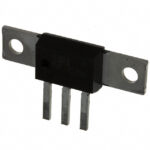 113CNQ100A
The activity of extra discounts on wholesale prices is in full swing…
Please fill in your contact information and we will send you the latest wholesale price list.





