 ChipApex | Global Electronic Components Supplier
SEARCH
Search Product
Search Post
— IC芯片 | 连接器 | 传感器 | 被动器件 —
Search productSearch post
— IC芯片 | 连接器 | 传感器 | 被动器件 —
Consult the customer manager about the wholesale price.
consultation hotline:86-132-6715-2157
email:[email protected]
Contact the product manager for consultation. One-stop consultation is available.
Do you want a lower wholesale price? Please send us your inquiry and we will reply immediately.
The Microchip Technology 11LC010T-E/SN is a 1 Kbit (128 x 8) serial EEPROM utilizing the UNI/O single-wire interface. It operates within a voltage range of 2.5 V to 5.5 V and supports a maximum bus frequency of 100 kHz. The device features a 16-byte page-write buffer, self-timed write cycles, and block write protection. It is housed in an 8-lead MSOP package and rated for an extended industrial temperature range of -40°C to +125°C.
Verify that the ordering suffix 'E' confirms the automotive-grade temperature rating (-40°C to +125°C). Confirm the 'SN' suffix corresponds to the 8-lead MSOP package type. Ensure the 'T' indicates tape-and-reel packaging if required by assembly equipment. Cross-reference the datasheet revision to confirm compatibility with specific application requirements.
Select this component when a single-wire interface is necessary to minimize pin count. Choose the 11LC010T-E/SN over the Industrial grade variant if operation at temperatures up to +125°C is required. Consider the 16-byte page buffer for efficient sequential writing. Verify that the 2.5 V minimum supply voltage aligns with the system's power rails.
This part belongs to the 11LCXXX family of serial EEPROMs from Microchip Technology. These devices are designed for applications requiring non-volatile storage with minimal interface complexity. The family shares common command sets and electrical characteristics, differing primarily in density, voltage ranges, and temperature grades.
Direct substitutes include other 11LC010 variants such as 11LC010-I/MS for industrial temperature ranges or different packages like SOIC-8. For automotive applications, verify availability of equivalent UNI/O compatible parts from other manufacturers if the Microchip part is unavailable.
The UNI/O interface combines clock and data into a single serial bit stream (SCIO) using Manchester encoding. The receiver extracts the clock signal internally to decode timing and data values.
If a page write attempts to cross a physical page boundary, the address counter rolls over to the beginning of the current page. Data wraps around, potentially overwriting previously stored data instead of writing to the next page.
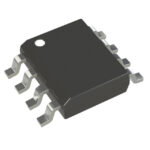 11LC010T-E/SN
The activity of extra discounts on wholesale prices is in full swing…
Please fill in your contact information and we will send you the latest wholesale price list.





