 ChipApex | Global Electronic Components Supplier
SEARCH
Search Product
Search Post
— IC芯片 | 连接器 | 传感器 | 被动器件 —
Search productSearch post
— IC芯片 | 连接器 | 传感器 | 被动器件 —
Consult the customer manager about the wholesale price.
consultation hotline:86-132-6715-2157
email:[email protected]
Contact the product manager for consultation. One-stop consultation is available.
Do you want a lower wholesale price? Please send us your inquiry and we will reply immediately.
The Würth Elektronik part number 14230326301 is a Triac output optocoupler belonging to the WL-OCTR series. It features a DIP-6 package and provides one channel of isolation with a rated isolation voltage of 5kVrms. The device incorporates a zero-crossing detection mechanism for its Triac output stage, which supports a peak repetitive off-state voltage of 250V. Key electrical characteristics include a power dissipation rating of 400mW and an input current requirement of 10mA.
Verify the specific datasheet version for the WL-OCTR series before integration. Confirm that the 250V peak off-state voltage meets the circuit requirements. Ensure the DIP-6 footprint matches the PCB layout. Check for SVHC compliance status as per REACH regulations. Validate thermal management for the 400mW power dissipation limit in the final assembly.
Select this component when zero-crossing switching is required to minimize electromagnetic interference during AC load activation. The 5kVrms isolation rating makes it suitable for applications requiring robust galvanic separation between control and high-voltage sides. Consider the DIP-6 form factor for through-hole mounting constraints. Evaluate the 10mA input current against the driving logic levels available in the system design.
This component is part of the Würth Elektronik WL-OCTR family of Triac output optocouplers. These devices are engineered for general-purpose electronic applications where reliable AC switching and electrical isolation are necessary. The series emphasizes safety and performance in low-power control scenarios involving resistive or inductive AC loads.
Consult official Wurth Elektronik documentation for direct pin-compatible substitutes within the WL-OCTR series. Verify that any alternative maintains the 5kVrms isolation and zero-crossing functionality. Cross-reference package dimensions and electrical ratings to ensure compatibility with existing board layouts and thermal profiles.
The Triac output operates in zero-crossing mode.
The device supports an isolation voltage of 5kVrms.
The peak repetitive off-state voltage is 250V.
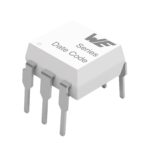 14230326301
The activity of extra discounts on wholesale prices is in full swing…
Please fill in your contact information and we will send you the latest wholesale price list.






