ChipApex | Global Electronic Components Supplier
SEARCH
Search Product
Search Post
— IC芯片 | 连接器 | 传感器 | 被动器件 —
Search productSearch post
— IC芯片 | 连接器 | 传感器 | 被动器件 —
Consult the customer manager about the wholesale price.
consultation hotline:86-132-6715-2157
email:[email protected]
Contact the product manager for consultation. One-stop consultation is available.
Do you want a lower wholesale price? Please send us your inquiry and we will reply immediately.
The 1553H-32K768J33DTSK is a crystal oscillator (XO) manufactured by Suzhou Hangjing Elec&Tech Co., Ltd. It operates at a frequency of 32.768 kHz and utilizes HCMOS output logic levels. The device is designed for a supply voltage of 3.3V and features an enable/disable control function. It is housed in a compact 4-SMD, no lead package configuration. The component is RoHS compliant and classified under MSL level 1, indicating unlimited sensitivity to moisture. This standard oscillator is intended for precise timing applications requiring low power consumption and stable frequency generation.
Verify the specific manufacturer datasheet for electrical tolerances and thermal characteristics before integration. Confirm that the 4-SMD no lead package aligns with your PCB footprint requirements. Ensure the 3.3V supply voltage matches your system design constraints. Check for any specific handling instructions related to the HCMOS output drive strength. Validate compliance with project-specific regulatory standards beyond RoHS if applicable.
Choose this component when a 32.768 kHz reference is required for timekeeping or synchronization tasks. The HCMOS output ensures direct interfacing with microcontrollers without additional buffering. The enable pin allows for dynamic power reduction during idle periods. Consider the physical dimensions of the 4-SMD package against available board space. Verify that the operating temperature range meets the environmental conditions of the end application.
This part belongs to the 1553H series of quartz frequency control units produced by Suzhou Hangjing. The company specializes in research and development of such components since 2014. The series typically includes various frequencies and voltage options, such as 5.0V variants. This specific model represents a standard low-frequency oscillator optimized for cost-effective and reliable timing solutions in mass-produced electronic devices.
Cross-reference with other 32.768 kHz HCMOS oscillators in 4-SMD packages. Ensure compatible supply voltage and output logic levels. Verify package dimensions and pinout compatibility for direct substitution. Check equivalent performance metrics such as stability and phase noise if critical to the application.
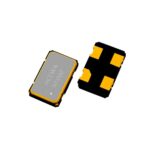 1553H-32K768J33DTSK
The activity of extra discounts on wholesale prices is in full swing…
Please fill in your contact information and we will send you the latest wholesale price list.