 ChipApex | Global Electronic Components Supplier
SEARCH
Search Product
Search Post
— IC芯片 | 连接器 | 传感器 | 被动器件 —
Search productSearch post
— IC芯片 | 连接器 | 传感器 | 被动器件 —
Consult the customer manager about the wholesale price.
consultation hotline:86-132-6715-2157
email:[email protected]
Contact the product manager for consultation. One-stop consultation is available.
Do you want a lower wholesale price? Please send us your inquiry and we will reply immediately.
The Vishay 16TTS08 is a phase control silicon controlled rectifier (SCR) in the High Voltage Series, housed in a TO-220AB package. It features glass passivation for reliable operation up to a junction temperature of 125 °C. Key electrical ratings include a maximum repetitive peak reverse voltage (VRRM) of 800 V and a maximum average on-state current (IT(AV)) of 10 A at 98 °C case temperature with half-sine wave conduction. The device supports a non-repetitive surge current (ITSM) of 200 A and has a typical on-state voltage drop (VT) of 1.4 V at 10 A. Triggering requires a maximum DC gate current of 60 mA at 25 °C.
Verify the specific ordering suffix against the manufacturer's official documentation to confirm lead-free status and production type. Ensure the selected part matches the required voltage rating, as the series includes variants with different breakdown voltages. Confirm that the TO-220AB package dimensions align with the thermal management design requirements for the intended application environment.
Select this component based on its 800 V blocking capability and 10 A continuous current handling. Evaluate the thermal resistance characteristics to ensure adequate heat sinking for maintaining junction temperatures within the specified range. Consider the dV/dt and dI/dt ratings when designing snubber circuits or managing rapid transient conditions in the load path.
This SCR belongs to the 16TTS.. High Voltage Series from Vishay High Power Products. The series is engineered for robust industrial use, offering standardized mounting options. The 16TTS08 variant specifically addresses applications requiring high voltage isolation combined with moderate current capacity, fitting into the broader portfolio of discrete semiconductor solutions for power conversion systems.
The datasheet lists the 16TTS12 as a related part number within the same series, differing primarily in voltage rating rather than physical form factor. Verify pinout compatibility and thermal specifications before substituting.
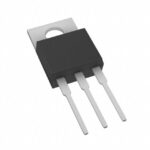 16TTS08
The activity of extra discounts on wholesale prices is in full swing…
Please fill in your contact information and we will send you the latest wholesale price list.





