 ChipApex | Global Electronic Components Supplier

SEARCH
Search Product
Search Post
— IC芯片 | 连接器 | 传感器 | 被动器件 —
Search productSearch post
— IC芯片 | 连接器 | 传感器 | 被动器件 —
Consult the customer manager about the wholesale price.
consultation hotline:86-132-6715-2157
email:[email protected]
Contact the product manager for consultation. One-stop consultation is available.
Do you want a lower wholesale price? Please send us your inquiry and we will reply immediately.
The 18QHTF21-49.370-OE is a standard crystal oscillator manufactured by Mercury Electronic Ind. Co., Ltd. It operates at a frequency of 49.370 MHz and utilizes LVCMOS output logic. The device functions with a supply voltage of 1.8V and includes enable/disable control capabilities. It is housed in a compact 4-SMD, no-lead package with dimensions of 2.0mm x 1.6mm. This component is designed for timing applications requiring precise clock signals within specified operating temperature ranges.
Verify the specific frequency tolerance and load capacitance requirements against your circuit design before procurement. Confirm that the 1.8V supply voltage aligns with your system's power rails. Ensure the PCB footprint matches the 2.0x1.6mm SMD package dimensions. Check for any specific reflow soldering profile recommendations provided by the manufacturer to ensure reliable assembly and long-term performance.
Select this oscillator when a precise 49.370 MHz clock source is required for LVCMOS-compatible logic families. Consider the 1.8V operating voltage if your system uses low-power logic standards. The enable/disable feature allows for power management strategies where the clock can be gated during idle periods. Evaluate the thermal characteristics and operating temperature range to ensure compatibility with your environmental conditions.
This part belongs to the 18QHTF21 series from Mercury Electronic Ind. Co., Ltd, which offers various frequency options within the same physical package. The series is characterized by its small form factor and low power consumption. Mercury Electronics specializes in quartz crystals and oscillators, providing timing solutions for diverse electronic applications. The -OE suffix typically denotes a specific packaging or tape-and-reel configuration, though exact details should be confirmed via the datasheet.
Direct replacements must match the 49.370 MHz frequency, 1.8V supply, LVCMOS output, and 4-SMD 2.0x1.6mm package. Verify pinout compatibility and electrical specifications such as jitter and phase noise. Consult the manufacturer's official substitution list for approved alternatives.
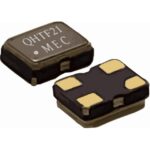 18QHTF21-49.370-OE

The activity of extra discounts on wholesale prices is in full swing…
Please fill in your contact information and we will send you the latest wholesale price list.





