 ChipApex | Global Electronic Components Supplier

SEARCH
Search Product
Search Post
— IC芯片 | 连接器 | 传感器 | 被动器件 —
Search productSearch post
— IC芯片 | 连接器 | 传感器 | 被动器件 —
Consult the customer manager about the wholesale price.
consultation hotline:86-132-6715-2157
email:[email protected]
Contact the product manager for consultation. One-stop consultation is available.
Do you want a lower wholesale price? Please send us your inquiry and we will reply immediately.
The Mercury Electronics 18QHTF21-49.430-OE is a quartz crystal resonator designed for high-frequency applications. It operates at a fundamental frequency of 49.430 MHz. The component utilizes a surface-mount technology (SMT) package, specifically the 1812 footprint, to facilitate automated assembly and compact circuit board layouts. This resonator is engineered to provide stable oscillation with low phase noise characteristics suitable for precision timing requirements in electronic systems.
Verify the specific ordering suffix against the manufacturer's official documentation to ensure compatibility with required load capacitance and frequency tolerance specifications. Confirm that the package dimensions align with the designated footprint on the printed circuit board. Request the latest datasheet to validate electrical parameters such as equivalent series resistance and operating temperature range before finalizing procurement decisions.
Select this component based on the requirement for a 49.430 MHz reference signal in space-constrained designs. Ensure the application environment supports the specified operating temperature range. Evaluate the circuit's load capacitance requirements to match the resonator's specifications for optimal frequency accuracy. Consider the SMT package type for compatibility with existing assembly equipment and manufacturing processes.
This part belongs to the Mercury Electronics line of quartz crystal resonators, which are widely used in telecommunications and computing industries. The 18QHTF21 series represents a family of surface-mount devices offering various frequency options within a standardized package size. These components are integral to maintaining system synchronization and timing integrity in modern electronic hardware.
Consult the manufacturer's cross-reference guide for direct substitutes. Verify that any alternative component matches the 49.430 MHz frequency, 1812 package dimensions, and electrical characteristics. Ensure the replacement maintains the same fundamental mode operation and phase noise profile to guarantee system compatibility.
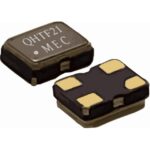 18QHTF21-49.430-OE

The activity of extra discounts on wholesale prices is in full swing…
Please fill in your contact information and we will send you the latest wholesale price list.




