 ChipApex | Global Electronic Components Supplier
SEARCH
Search Product
Search Post
— IC芯片 | 连接器 | 传感器 | 被动器件 —
Search productSearch post
— IC芯片 | 连接器 | 传感器 | 被动器件 —
Consult the customer manager about the wholesale price.
consultation hotline:86-132-6715-2157
email:[email protected]
Contact the product manager for consultation. One-stop consultation is available.
Do you want a lower wholesale price? Please send us your inquiry and we will reply immediately.
The 18QHTF21-7.056-OE is a standard crystal oscillator (XO) manufactured by Mercury Electronics Ind. Co. Ltd. It operates at a nominal frequency of 7.056 MHz and utilizes LVCMOS output logic levels. The device is designed for surface mount applications, featuring a compact 4-SMD, No Lead package with dimensions of 2.0x1.6 mm. It functions on a 1.8V supply voltage and includes an enable/disable control pin for power management. The unit supports an operating temperature range from -40°C to 85°C and exhibits a frequency stability of ±50ppm.
Verify the specific suffix 'OE' against official Mercury Electronics documentation to confirm the exact enable/disable configuration and packaging variant. Ensure that the 1.8V supply requirement aligns with the target system's voltage rails before integration. Cross-reference the 4-SMD No Lead footprint dimensions with the PCB layout guidelines provided in the manufacturer's datasheet to prevent assembly errors.
Select this component when a low-profile surface mount oscillator is required for 7.056 MHz applications. The choice is driven by the need for LVCMOS compatibility and a small 2.0x1.6 mm footprint. Consider the ±50ppm stability specification relative to the system's jitter tolerance requirements. The wide operating temperature range makes it suitable for environments subject to thermal variation.
This model belongs to the 18QHTF21 series of surface mount oscillators produced by Mercury Electronic Industrial Co., Ltd. The series is characterized by its small form factor and standardized electrical interfaces. Mercury Electronics has specialized in quartz crystal manufacturing since 1973, establishing itself as a pioneer in the industry. This specific part represents a standard XO variant within their portfolio of frequency control products.
Direct substitutes include other 7.056 MHz LVCMOS oscillators in 4-SMD packages with identical 1.8V supply and enable features. Verify mechanical footprint compatibility and pinout definitions before swapping. Alternative models from the same family may offer different stability grades or temperature ranges.
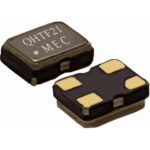 18QHTF21-7.056-OE
The activity of extra discounts on wholesale prices is in full swing…
Please fill in your contact information and we will send you the latest wholesale price list.





