 ChipApex | Global Electronic Components Supplier
SEARCH
Search Product
Search Post
— IC芯片 | 连接器 | 传感器 | 被动器件 —
Search productSearch post
— IC芯片 | 连接器 | 传感器 | 被动器件 —
Consult the customer manager about the wholesale price.
consultation hotline:86-132-6715-2157
email:[email protected]
Contact the product manager for consultation. One-stop consultation is available.
Do you want a lower wholesale price? Please send us your inquiry and we will reply immediately.
The 18QHTF21-72.30417-OE is a crystal oscillator (XO) manufactured by Mercury Electronics Ind. Co., Ltd. It operates at a frequency of 72.30417 MHz with an LVCMOS output logic level. The device requires a supply voltage of 1.8V and features enable/disable functionality for power management. It is housed in a compact 4-SMD, No Lead package with dimensions of 2.0mm x 1.6mm. The component is RoHS compliant and classified under MSL Level 1, indicating unlimited shelf life under standard conditions.
Verify the specific suffix 'OE' against official Mercury Electronics documentation to confirm it denotes the correct enable/disable variant and packaging type. Ensure that the 1.8V supply requirement aligns with the target system's voltage rails before integration. Cross-reference the 4-SMD No Lead footprint with the manufacturer's recommended land pattern to guarantee proper soldering reliability and mechanical stability during assembly processes.
Select this component when a low-voltage 1.8V operation is required alongside standard LVCMOS signaling levels. The enable/disable feature makes it suitable for battery-powered or power-sensitive applications where active standby modes are necessary. Consider the small 2.0x1.6mm package size if board real estate is limited. Verify that the operating temperature range meets the environmental specifications of the final application environment.
This part belongs to the QHTF series of oscillators from Mercury Electronics, a pioneer in quartz crystal manufacturing since 1973. The series includes various differential and single-ended oscillators designed for high-frequency stability. The 18QHTF21 model specifically targets applications requiring precise timing in a miniature form factor, leveraging the company's long-standing expertise in Taiwan's quartz industry.
Direct substitutes may include other 72.30417 MHz LVCMOS oscillators in 4-SMD packages from different manufacturers, provided they match the 1.8V supply and pinout. Check datasheets for equivalent enable/disable functionality and similar dimensional constraints to ensure mechanical interchangeability without PCB redesign.
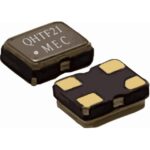 18QHTF21-72.30417-OE
The activity of extra discounts on wholesale prices is in full swing…
Please fill in your contact information and we will send you the latest wholesale price list.





