 ChipApex | Global Electronic Components Supplier

SEARCH
Search Product
Search Post
— IC芯片 | 连接器 | 传感器 | 被动器件 —
Search productSearch post
— IC芯片 | 连接器 | 传感器 | 被动器件 —
Consult the customer manager about the wholesale price.
consultation hotline:86-132-6715-2157
email:[email protected]
Contact the product manager for consultation. One-stop consultation is available.
Do you want a lower wholesale price? Please send us your inquiry and we will reply immediately.
The Microchip Technology 1N3157A is an 8.4 V nominal voltage temperature compensated Zener reference diode housed in a hermetically sealed glass DO-7 (DO-204AA) package. It operates at a test current of 10 mA with a maximum reverse leakage current of 10 µA at 5.5 V and a maximum Zener impedance of 15 Ω. The device provides a maximum temperature coefficient of 0.001 %/°C over a temperature range of -55°C to +150°C, ensuring minimal voltage change across broad thermal conditions.
Verify the specific suffix requirements when ordering, as tighter tolerance options are available by adding hyphenated suffixes to the part number. Confirm RoHS compliance status if required, noting that military qualifications utilize different prefixes and suffixes. Ensure the operating current aligns with the specified 10 mA for optimal voltage-temperature stability during implementation.
Select this component when a precise 8.4 V reference with ultra-low temperature drift is necessary. The 1N3157A offers the lowest temperature coefficient in its series, making it ideal for high-precision environments. Consider the DO-7 package dimensions and lead configuration for board layout compatibility. Evaluate the need for military or radiation-hardened variants if operating in extreme conditions.
This device belongs to the popular 1N3154 thru 1N3157A series of Zero-TC Reference Diodes. The series provides a selection of 8.4 V nominal voltages with varying temperature coefficients down to 0.001 %/°C. These glass axial-leaded reference diodes are also available in JAN, JANTX, and JANTXV military qualifications, as well as radiation-hardened versions with an RH prefix.
Equivalent devices include the 1N3156A for slightly higher temperature coefficients or the 1N3155A for broader commercial availability. Military equivalents can be sourced using JAN, JANTX, or JANTXV prefixes. Radiation-hardened alternatives are available with the RH prefix, such as RH3157A.
Operating the diode at currents other than the specified 10 mA will alter the temperature coefficient. Graphs provided in the datasheet allow estimation of these changes based on the specific operating current.
The DC power dissipation is rated at 500 mW at a lead temperature of 25°C, with a maximum current of 55 mA. For optimum stability, operation at 10 mA results in less than 90 mW of dissipated power.
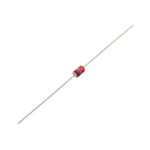 1N3157A

The activity of extra discounts on wholesale prices is in full swing…
Please fill in your contact information and we will send you the latest wholesale price list.





