 ChipApex | Global Electronic Components Supplier

SEARCH
Search Product
Search Post
— IC芯片 | 连接器 | 传感器 | 被动器件 —
Search productSearch post
— IC芯片 | 连接器 | 传感器 | 被动器件 —
Consult the customer manager about the wholesale price.
consultation hotline:86-132-6715-2157
email:[email protected]
Contact the product manager for consultation. One-stop consultation is available.
Do you want a lower wholesale price? Please send us your inquiry and we will reply immediately.
1N4112-1 is listed in the Single Zener Diodes range at ChipApex. The manufacturer field lists Microchip Technology. Its product description is DIODE ZENER 18V 500MW DO204AH. Review the specifications below when checking this part for your BOM.
The Microchip Technology 1N4112-1 is a 500 mW metallurgically bonded glass Zener diode in the axial-lead DO-35 package. It provides an 18 V nominal Zener voltage with a standard ±5% tolerance. The device operates within a junction temperature range of -65 °C to +175 °C and features a maximum reverse leakage current of 13.7 µA at the specified test voltage. Electrical characteristics include a dynamic impedance of 0.05 Ω, a maximum noise density of 40 µV/√Hz, and a positive temperature coefficient of +0.090 %/°C.
Verify the specific qualification level (JAN, JANTX, JANTXV, or JANS) required for your application, as these levels dictate the manufacturing lot traceability and screening standards. Confirm RoHS compliance status, noting that compliant versions are available only on commercial grades. Ensure ordering suffixes match the desired packaging format, such as tape and reel options.
Select this component when a stable 18 V reference is needed in harsh environments due to its wide operating temperature range and radiation hardness. Consider the low dynamic impedance and minimal capacitance for precision applications. Evaluate the power derating curve if ambient temperatures exceed 25 °C to ensure the 500 mW rating remains within safe limits.
This part belongs to the 1N4099-1 through 1N4135-1 series of 500 mZener regulators. These devices cover a voltage range from 1.8 V to 100 V and are JEDEC registered. They share common construction features, including the DO-35 glass package and metallurgical bonding technology designed for durability in demanding electronic systems.
Equivalent parts within the same series include 1N4111-1 and 1N4113-1. Verify that any substitute matches the exact Zener voltage, tolerance class, and required reliability qualification level.
The diode must be operated with the banded end positive with respect to the opposite end to achieve Zener regulation.
It is derived by superimposing a 60 Hz rms AC current at 10% of the test current onto the DC test current.
Explore related parts through Zener, Diodes, Discrete Semiconductor Products, all product categories.
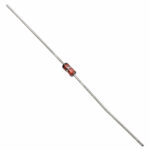 1N4112-1

The activity of extra discounts on wholesale prices is in full swing…
Please fill in your contact information and we will send you the latest wholesale price list.





