 ChipApex | Global Electronic Components Supplier
SEARCH
Search Product
Search Post
— IC芯片 | 连接器 | 传感器 | 被动器件 —
Search productSearch post
— IC芯片 | 连接器 | 传感器 | 被动器件 —
Consult the customer manager about the wholesale price.
consultation hotline:86-132-6715-2157
email:[email protected]
Contact the product manager for consultation. One-stop consultation is available.
Do you want a lower wholesale price? Please send us your inquiry and we will reply immediately.
The Microsemi Corporation 1N5348B is a silicon 5-watt Zener diode in the JEDEC registered 1N5333-5388B series. It provides voltage regulation with a nominal Zener voltage of 11 V and a standard tolerance of ±5%. The device features a T-18 axial lead package and operates within a temperature range of -65°C to +150°C. Electrical characteristics include a maximum dynamic impedance of 2.5 Ohms, a maximum reverse current of 5 µA at 8.0 V, and a maximum regulator current of 8.4 A when adequately heat sunk.
Verify the specific suffix (e.g., e3 for RoHS compliance or TR for tape and reel) against project requirements, as these alter packaging and environmental status without changing electrical function. Confirm availability of military screening prefixes if JAN or JANTX levels are required. Ensure adequate thermal management design is implemented to support the 5-watt dissipation rating.
Select this component for applications demanding robust 5-watt power dissipation and wide temperature operation. The ±5% tolerance suits general regulation needs, while tighter tolerances require C or D suffixes. Consider the T-18 package dimensions for board layout and verify that the 2.5 Ohm dynamic impedance meets circuit stability requirements.
This part belongs to the Microsemi 1N5333B-1N5388B series of silicon 5-watt Zener diodes. The series covers a voltage range from 3.3 V to 200 V, offering various tolerance options via suffix letters. These devices are designed for high-current operation with low thermal resistance, serving as a standard solution for power regulation and transient suppression in demanding environments.
Surface mount equivalents such as SMBJ5348B or SMBG5348B are available from the same manufacturer. Cross-manufacturer replacements must match the 11 V Zener voltage, 5 W power rating, and T-18 or equivalent axial package form factor.
The maximum surge current (IZSM) is specified as 430 A for a non-recurrent half-sine wave of 8.3 ms duration.
Polarity is indicated by a band on the cathode end. The diode must be operated with the banded end positive with respect to the opposite end.
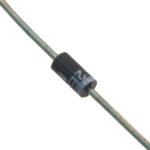 1N5348B
The activity of extra discounts on wholesale prices is in full swing…
Please fill in your contact information and we will send you the latest wholesale price list.





