 ChipApex | Global Electronic Components Supplier
SEARCH
Search Product
Search Post
— IC芯片 | 连接器 | 传感器 | 被动器件 —
Search productSearch post
— IC芯片 | 连接器 | 传感器 | 被动器件 —
Consult the customer manager about the wholesale price.
consultation hotline:86-132-6715-2157
email:[email protected]
Contact the product manager for consultation. One-stop consultation is available.
Do you want a lower wholesale price? Please send us your inquiry and we will reply immediately.
The Microsemi Corporation 1N5354B is a silicon 5.0-watt Zener diode from the JEDEC registered 1N5333-5388B series, housed in a T-18 axial-lead plastic package. It provides voltage regulation at a nominal Zener voltage of 17 V with a standard tolerance of ±5%. The device operates within a temperature range of -65°C to +150°C and features a maximum reverse current of 0.5 µA at 12.9 V. It withstands high surge stresses and maintains minimal voltage changes versus current.
Verify the specific manufacturer source, as this part number is produced by multiple vendors including Microsemi and MCC. Confirm RoHS compliance status if required, noting that e3 suffixes indicate compliance. Ensure the package type matches the design requirements, as variations exist between DO-15 and T-18 axial leads. Check for military screening prefixes if high reliability is needed.
Select based on the required Zener voltage and power dissipation capabilities. Consider thermal resistance and heat sinking requirements for steady-state operation. Verify tolerance needs, as tighter tolerances require specific suffixes. Evaluate the operating temperature range against environmental conditions. Ensure the package style aligns with the PCB layout constraints.
This component belongs to the 1N5333B through 1N5388B series of 5-watt silicon Zener diodes. The series offers a wide selection of voltages from 3.3V to 200V. Different suffix letters identify specific voltage tolerances. The devices are designed for applications requiring high maximum DC currents with adequate heat sinking.
Surface mount equivalents are available as SMBJ5333 to SMBJ5388B or SMBG5333B to SMBG5388B. Other manufacturers produce compatible parts such as the 1N5354B-TP. Verify electrical parameters and physical dimensions before substitution.
The standard voltage tolerance for the B suffix designation is plus or minus 5%.
Polarity is indicated by a band on the cathode end. The diode must be operated with the banded end positive with respect to the opposite end.
No, the device is nonsensitive to ESD per MIL-STD-750 Method 1020.
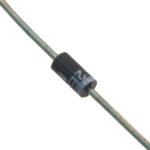 1N5354B
The activity of extra discounts on wholesale prices is in full swing…
Please fill in your contact information and we will send you the latest wholesale price list.





