 ChipApex | Global Electronic Components Supplier
SEARCH
Search Product
Search Post
— IC芯片 | 连接器 | 传感器 | 被动器件 —
Search productSearch post
— IC芯片 | 连接器 | 传感器 | 被动器件 —
Consult the customer manager about the wholesale price.
consultation hotline:86-132-6715-2157
email:[email protected]
Contact the product manager for consultation. One-stop consultation is available.
Do you want a lower wholesale price? Please send us your inquiry and we will reply immediately.
The onsemi 1N5359BG is a single-channel Zener voltage regulator diode belonging to the 1N53xxB series. It features a nominal Zener voltage of 24 V with a tolerance of ±5%. The device supports a maximum power dissipation of 5 W and operates within a temperature range of -65°C to +200°C. Packaged in an axial lead DO-15 (Case 017AA) format, it exhibits a maximum Zener impedance of 3.5 Ω at a test current of 50 mA. The component ensures low reverse leakage current of 500 nA and offers high surge capability for robust voltage regulation applications.
Verify the specific ordering suffix against official documentation to confirm packaging configuration, as suffixes may indicate variations in shipping format such as bulk or tape-and-reel without altering electrical performance. Confirm RoHS compliance status through the manufacturer's material declaration. Ensure the requested part number matches the exact voltage and power specifications required for the design to avoid functional mismatches.
Select this component when a 24 V reference with 5 W power handling is required in an axial package. Consider the ±5% tolerance and 3.5 Ω impedance for precision requirements. Evaluate the thermal derating characteristics above 75°C to ensure adequate heat dissipation in the final assembly. Compare against other series members if different voltage levels are needed while maintaining the same physical footprint.
This device is part of the 1N53xxB series of 5 Watt Zener diodes manufactured by onsemi. The series utilizes advanced silicon-oxide passivation to enhance operating characteristics and longevity. These components are designed for through-hole mounting and are suitable for environments requiring high reliability and resistance to common mechanical and chemical stresses.
Cross-reference with other manufacturers offering equivalent 24 V, 5 W axial Zener diodes. Verify pinout compatibility and package dimensions before substitution. Check for differences in dynamic impedance and leakage current specifications to ensure circuit performance remains within acceptable limits.
The maximum operating junction temperature is +200°C.
No, this component is not qualified for automotive standards according to available data.
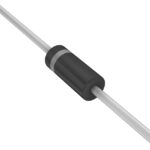 1N5359BG
The activity of extra discounts on wholesale prices is in full swing…
Please fill in your contact information and we will send you the latest wholesale price list.





