 ChipApex | Global Electronic Components Supplier
SEARCH
Search Product
Search Post
— IC芯片 | 连接器 | 传感器 | 被动器件 —
Search productSearch post
— IC芯片 | 连接器 | 传感器 | 被动器件 —
Consult the customer manager about the wholesale price.
consultation hotline:86-132-6715-2157
email:[email protected]
Contact the product manager for consultation. One-stop consultation is available.
Do you want a lower wholesale price? Please send us your inquiry and we will reply immediately.
The Diotec Semiconductor 1N5369B is a non-planar Zener diode housed in a DO-201 axial leaded package. It features a nominal Zener voltage of 51 V with a standard E24 tolerance of approximately ±5%. The device supports a maximum power dissipation of 5 W at 50°C ambient temperature and withstands non-repetitive peak pulse power of 80 W for durations under 8.3 ms. Operating junction temperatures range from -50°C to +150°C, with storage limits extending to +175°C. Key electrical characteristics include a test current of 25 mA, dynamic resistance of 27 Ω, and a reverse leakage current of less than 38.8 µA at 230 V reverse voltage.
Verify the specific ordering suffix when purchasing. Standard versions lack automotive qualification, while suffixes such as -Q indicate AEC-Q101 compliance and -AQ denotes active qualification status. Confirm that the required component matches the intended reliability grade for your specific commercial or industrial application environment before finalizing orders.
Select this component for designs requiring robust 5 W power handling in an axial package. Ensure the circuit operates within the specified thermal constraints, maintaining leads at ambient temperature at a 10 mm distance from the case for accurate rating validation. Consider the dynamic resistance and test current requirements to ensure proper regulation performance in your specific load conditions.
This component belongs to the 1N5345B through 1N5388B series of Zener diodes manufactured by Diotec Semiconductor. The series utilizes flächendiffundierte (planar diffused) non-planar technology to achieve high power ratings. The 1N5369B specifically occupies the mid-range of the series, offering a 51 V breakdown voltage suitable for general-purpose industrial voltage reference and protection tasks.
Cross-reference with other manufacturers' 1N5369 equivalents. Verify that substitute components match the DO-201 package dimensions, 5 W power rating, and 51 V Zener voltage tolerance. Ensure thermal resistance characteristics are compatible with your existing heat dissipation design.
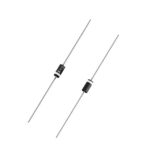 1N5369B
The activity of extra discounts on wholesale prices is in full swing…
Please fill in your contact information and we will send you the latest wholesale price list.





