 ChipApex | Global Electronic Components Supplier
SEARCH
Search Product
Search Post
— IC芯片 | 连接器 | 传感器 | 被动器件 —
Search productSearch post
— IC芯片 | 连接器 | 传感器 | 被动器件 —
Consult the customer manager about the wholesale price.
consultation hotline:86-132-6715-2157
email:[email protected]
Contact the product manager for consultation. One-stop consultation is available.
Do you want a lower wholesale price? Please send us your inquiry and we will reply immediately.
The 1N5401GHA0G is a general-purpose silicon rectifier diode manufactured by Taiwan Semiconductor Corporation. It features a maximum average forward rectified current of 3 A and a maximum repetitive peak reverse voltage of 100 V. The device utilizes a DO-201AD axial leaded package with an isolated case connection. Electrical characteristics include a maximum non-repetitive peak forward surge current of 125 A and a maximum DC blocking voltage of 100 V. The component operates within a temperature range from -55 °C to 150 °C, ensuring high reliability and low power loss for standard rectification applications.
Verify the specific suffix GHA0G against manufacturer documentation to confirm compliance attributes such as halogen-free status and AEC-Q101 qualification. Ensure the ordering code matches the required packing prefix for whisker test compliance. Cross-reference datasheet parameters like VF and IFSM with system requirements before procurement to avoid specification mismatches.
Select this component for applications requiring a 3 A continuous current rating with a 100 V reverse voltage block. The DO-201AD package suits through-hole mounting where higher thermal mass is beneficial. Consider the 125 A surge rating for inductive load switching. Verify that the 150 °C junction temperature limit aligns with the thermal design of the target enclosure or heatsink configuration.
This part belongs to the 1N540x series of glass-passivated rectifiers, which are standardized for general-purpose power rectification. The GHA0G suffix indicates specific manufacturing attributes including halogen-free molding compound and potential automotive qualification prefixes. It serves as a direct replacement for legacy 1N5401 specifications while offering modern regulatory compliance and improved reliability metrics compared to older generic equivalents.
Direct substitutes include other manufacturers' 1N5401 variants in DO-201AD packages. Verify that alternative parts meet the 125 A surge current requirement and 150 °C operating temperature limit. Check if the replacement offers similar glass passivation for comparable long-term stability.
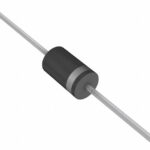 1N5401GHA0G
The activity of extra discounts on wholesale prices is in full swing…
Please fill in your contact information and we will send you the latest wholesale price list.





