 ChipApex | Global Electronic Components Supplier
SEARCH
Search Product
Search Post
— IC芯片 | 连接器 | 传感器 | 被动器件 —
Search productSearch post
— IC芯片 | 连接器 | 传感器 | 被动器件 —
Consult the customer manager about the wholesale price.
consultation hotline:86-132-6715-2157
email:[email protected]
Contact the product manager for consultation. One-stop consultation is available.
Do you want a lower wholesale price? Please send us your inquiry and we will reply immediately.
The 1N5402G-K is a silicon rectifier diode manufactured by Taiwan Semiconductor Corporation. It features an average forward current rating of 3.0 A and a maximum repetitive peak reverse voltage of 200 V. The device utilizes a glass passivated junction for enhanced stability and reliability under varying conditions. It is housed in the DO-201AD axial leaded package, which provides robust mechanical support. Key electrical characteristics include a non-repetitive peak forward surge current capability of 200 A and a low leakage current of 5.0 µA at rated voltage. The component supports a maximum operating junction temperature of 150 °C.
Verify the specific manufacturer datasheet to confirm compliance with RoHS directives and REACH regulations. Ensure the DO-201AD package dimensions match your PCB footprint requirements. Confirm that the glass passivation type aligns with your environmental stress testing standards. Cross-reference the thermal resistance values against your system's heat dissipation capabilities before finalizing procurement.
Select this component when a standard 3.0 A rectifier with a 200 V blocking voltage is required. The DO-201AD package offers superior heat dissipation compared to smaller surface-mount alternatives. Consider the glass passivation for environments requiring higher stability than epoxy encapsulated devices. Evaluate the 200 A surge rating against potential inrush currents in your specific application design.
This part belongs to the widely recognized 1N54xx series of general-purpose rectifiers. These components are industry-standard replacements for legacy designs requiring reliable AC-to-DC conversion. The 1N5402 variant specifically targets applications needing 200 V reverse voltage tolerance. Its availability from multiple manufacturers ensures supply chain flexibility for mass production.
Compatible substitutes include Vishay 1N5402-E3/66 and New Jersey Semiconductor 1N5402. Verify that replacement parts maintain the same DO-201AD package outline and pin configuration. Ensure equivalent electrical ratings for forward current and reverse voltage are met.
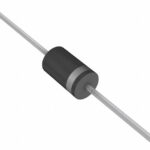 1N5402G-K
The activity of extra discounts on wholesale prices is in full swing…
Please fill in your contact information and we will send you the latest wholesale price list.





