 ChipApex | Global Electronic Components Supplier
SEARCH
Search Product
Search Post
— IC芯片 | 连接器 | 传感器 | 被动器件 —
Search productSearch post
— IC芯片 | 连接器 | 传感器 | 被动器件 —
Consult the customer manager about the wholesale price.
consultation hotline:86-132-6715-2157
email:[email protected]
Contact the product manager for consultation. One-stop consultation is available.
Do you want a lower wholesale price? Please send us your inquiry and we will reply immediately.
The Microchip Technology 1N5712-1E3/TR is a small-signal Schottky barrier diode designed for through-hole mounting in the DO-35-2 axial leaded package. It features a single configuration with silicon technology, supporting a maximum average forward current of 75 mA and a repetitive peak reverse voltage of 16 V. The device exhibits a low forward voltage drop of 1 V at rated current and a maximum reverse leakage current of 150 nA. It operates reliably within an extended temperature range from -65°C to +150°C junction temperature. This component is supplied in tape and reel packaging.
Verify the specific suffix -1E3/TR confirms the lead-free status and tape-and-reel packaging format required for automated assembly processes. Confirm that the DO-35-2 package dimensions match the target PCB footprint. Ensure the 16 V reverse voltage rating provides sufficient margin for the intended circuit's peak inverse voltage conditions. Validate compliance requirements against project specifications.
Select this component when a low-loss, high-speed switching diode is required in a through-hole design. The 75 mA current rating suits low-power signal or control applications rather than high-current power delivery. Consider the 16 V voltage limit carefully; higher voltage variants are necessary for mains or industrial bus applications. The wide temperature range supports operation in harsh environments where standard silicon diodes might fail.
This part belongs to the JEDEC registered 1N5712 series of Schottky barrier diodes manufactured by Microchip Technology. It serves as the commercial, lead-free, reel-packaged version of the standard 1N5712 diode. The series is widely recognized for its reliability in general-purpose rectification and switching applications requiring fast recovery characteristics.
Direct replacements include the non-tape variant 1N5712 for bulk handling or the 1N5712-1 for specific military qualification needs if applicable. Verify pinout compatibility and thermal resistance differences when substituting.
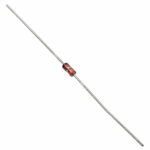 1N5712-1E3/TR
The activity of extra discounts on wholesale prices is in full swing…
Please fill in your contact information and we will send you the latest wholesale price list.






