 ChipApex | Global Electronic Components Supplier
SEARCH
Search Product
Search Post
— IC芯片 | 连接器 | 传感器 | 被动器件 —
Search productSearch post
— IC芯片 | 连接器 | 传感器 | 被动器件 —
Consult the customer manager about the wholesale price.
consultation hotline:86-132-6715-2157
email:[email protected]
Contact the product manager for consultation. One-stop consultation is available.
Do you want a lower wholesale price? Please send us your inquiry and we will reply immediately.
The Microchip Technology 1N5803US/TR is a single fast recovery rectifier designed for surface mount applications. It features a maximum repetitive reverse voltage of 80 V and an average forward current rating of 1 A, with a surge current capacity of 35 A. The device exhibits a typical forward voltage drop of 975 mV at rated current and a maximum reverse leakage current of 1 µA. With a fast recovery time of 25 ns, it supports efficient power conversion in compact designs. The component operates within a temperature range of -65 °C to +175 °C and is housed in the D-5A SQ-MELF package.
Verify the specific suffix TR indicates tape and reel packaging configuration when ordering. Confirm RoHS status as N per available specifications. Ensure compatibility with D-5A footprint during PCB layout. Check lead times due to reported long delivery periods. Validate datasheet version against manufacturer documentation before final design approval.
Select this component where 80 V blocking voltage and 1 A continuous current meet circuit requirements. Consider the 25 ns recovery time suitability for operating frequencies above standard rectifiers. Evaluate thermal management needs given the +175 °C maximum rating. Compare forward voltage characteristics against system efficiency targets. Verify package dimensions match existing board space constraints.
This part belongs to the 1N58xx series of fast recovery rectifiers from Microchip Technology. It shares functional similarities with other members like the 1N5802US and 1N5804US, differentiated primarily by reverse voltage ratings. The US designation typically denotes the SQ-MELF surface mount package variant. These components are engineered for reliability in demanding electronic environments.
Direct substitutes include JANTX1N5804US/TR for higher voltage tolerance or JANTXV1N5802US/TR for lower voltage applications. Verify pinout and package compatibility before substitution. Ensure electrical parameters such as reverse voltage and recovery time align with original design specifications.
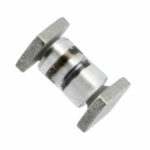 1N5803US/TR
The activity of extra discounts on wholesale prices is in full swing…
Please fill in your contact information and we will send you the latest wholesale price list.





