ChipApex | Global Electronic Components Supplier
SEARCH
Search Product
Search Post
— IC芯片 | 连接器 | 传感器 | 被动器件 —
Search productSearch post
— IC芯片 | 连接器 | 传感器 | 被动器件 —
Consult the customer manager about the wholesale price.
consultation hotline:86-132-6715-2157
email:[email protected]
Contact the product manager for consultation. One-stop consultation is available.
Do you want a lower wholesale price? Please send us your inquiry and we will reply immediately.
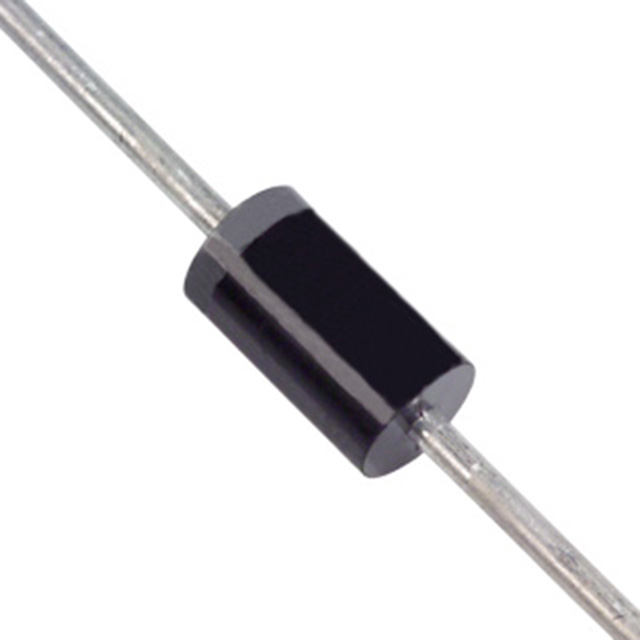
The Diodes Incorporated 1N5820-B is a Schottky barrier rectifier featuring a guard ring die construction for transient protection. It operates with a peak repetitive reverse voltage of 20 V and an average rectified output current of 3.0 A at a lead temperature of 95 °C. The device exhibits a maximum forward voltage drop of 0.475 V at 3.0 A and 0.500 V at 9.4 A, alongside a peak reverse current of 2.0 mA at 25 °C. It supports a non-repetitive peak forward surge current of 80 A and functions within a junction temperature range of -65 to +125 °C.
Verify the specific ordering suffix against manufacturer documentation to confirm exact electrical tolerances and packaging configurations. Ensure compatibility with required thermal management strategies, as performance depends on lead temperature and mounting position. Cross-reference datasheet notes regarding current derating for capacitive loads to validate circuit design integrity before procurement.
Select this component for applications requiring efficient rectification in low-voltage, high-frequency environments. Consider the 3.0 A continuous current rating and 20 V reverse voltage limits when designing power stages. Evaluate thermal resistance characteristics and derating curves to ensure reliable operation under varying load conditions and ambient temperatures.
This component belongs to the 1N5820-1N5822 series of 3.0A Schottky barrier rectifiers manufactured by Diodes Incorporated. The series utilizes DO-201AD axial leaded packages designed for robust performance in general-purpose rectification tasks. These devices are engineered to provide reliable operation in industrial and consumer electronics applications requiring high surge capability.
Direct substitutes include the 1N5820G from onsemi and the 1N5820-TP from Micro Commercial Components (MCC). Verify that alternative components match the 20 V reverse voltage and 3.0 A current specifications to maintain circuit functionality.
The typical total capacitance is measured at 25 °C junction temperature, 1 MHz frequency, and 50 mV p-p signal level.
The forward current must be derated based on the lead temperature, as illustrated in the forward current derating curve provided in the datasheet.
 1N5820-B
The activity of extra discounts on wholesale prices is in full swing…
Please fill in your contact information and we will send you the latest wholesale price list.