 ChipApex | Global Electronic Components Supplier
SEARCH
Search Product
Search Post
— IC芯片 | 连接器 | 传感器 | 被动器件 —
Search productSearch post
— IC芯片 | 连接器 | 传感器 | 被动器件 —
Consult the customer manager about the wholesale price.
consultation hotline:86-132-6715-2157
email:[email protected]
Contact the product manager for consultation. One-stop consultation is available.
Do you want a lower wholesale price? Please send us your inquiry and we will reply immediately.
The Microchip Technology 1N6346 is a military-qualified, hermetically sealed glass Zener diode with a nominal voltage of 82.0 V and a standard tolerance of ±5%. It operates within a junction temperature range of -65°C to +175°C and features a steady-state power dissipation of 0.5 W at a lead temperature of 75°C. The device exhibits a maximum reverse current of 10 µA at 25°C and 80 µA at 150°C, with a dynamic impedance of 0.115 Ω at the test current of 220 mA. It supports a maximum regulator current of 62 mA and withstands a surge current of 0.5 A for an 8.3 ms square wave.
Verify the specific reliability level (JAN, JANTX, JANTXV, or JANS) required for your application, as this affects qualification standards. Confirm RoHS compliance status if environmental regulations apply, noting that RoHS versions are commercial grade only. Ensure the ordering suffix matches the desired voltage tolerance and terminal finish specifications defined in the part nomenclature section.
Select the 1N6346 when an 82 V Zener reference is needed in a DO-35 axial-lead package. Consider tighter tolerances (±1% or ±2%) if available via specific ordering suffixes. Evaluate thermal derating curves based on lead temperature constraints, as the junction-to-lead thermal resistance varies by series group. Ensure the operating current remains within the specified IZM limits to maintain stable voltage regulation.
This component belongs to the 1N6309 through 1N6355D series of 500 mW glass Zener diodes. The series offers a broad selection of voltages from 2.4 V to 200 V. The 1N6346 specifically falls within the higher voltage range of this lineup, sharing common packaging and qualification standards with its peers while providing distinct electrical characteristics suited for mid-to-high voltage regulation tasks.
Direct substitutes must match the 82 V nominal Zener voltage, 0.5 W power rating, and DO-35 package. Verify that any replacement meets the same MIL-PRF-19500/533 reliability level and hermetic sealing requirements. Check compatibility with existing thermal management designs due to similar thermal resistance profiles.
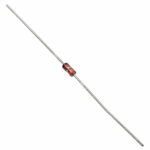 1N6346
The activity of extra discounts on wholesale prices is in full swing…
Please fill in your contact information and we will send you the latest wholesale price list.





