 ChipApex | Global Electronic Components Supplier
SEARCH
Search Product
Search Post
— IC芯片 | 连接器 | 传感器 | 被动器件 —
Search productSearch post
— IC芯片 | 连接器 | 传感器 | 被动器件 —
Consult the customer manager about the wholesale price.
consultation hotline:86-132-6715-2157
email:[email protected]
Contact the product manager for consultation. One-stop consultation is available.
Do you want a lower wholesale price? Please send us your inquiry and we will reply immediately.
The 1N646/TR is a silicon switching diode manufactured by Microchip Technology, designed for general-purpose rectification and signal processing applications. It utilizes the DO-35 axial through-hole package, providing reliable performance in compact circuit designs. The device features a maximum DC reverse voltage of 300 V and an average forward rectified current of 400 mA. Key electrical characteristics include a typical forward voltage of 1 V at 400 mA and a maximum reverse leakage current of 50 nA at 300 V. It operates within a junction temperature range of -65°C to 175°C and exhibits standard recovery speeds exceeding 500 ns.
Verify the specific suffix TR indicates tape-and-reel packaging when ordering. Confirm RoHS compliance status as documentation may vary by production batch. Ensure the supplier provides valid traceability records for quality assurance. Cross-reference the manufacturer part number with official Microchip databases to confirm current availability and lead times before finalizing procurement plans.
Select this component for applications requiring robust axial mounting and high reverse voltage tolerance. The 400 mA current rating suits moderate power levels where surface-mount options are unsuitable. Evaluate the standard recovery time against switching frequency requirements to ensure minimal distortion. Consider the DO-35 footprint constraints during PCB layout planning.
This part belongs to the standard silicon switching diode family produced by Microchip Technology. It serves as a fundamental discrete semiconductor component for basic electronic circuits. The DO-35 package is a legacy form factor widely used in industrial and commercial equipment. It complements other rectifier and protection devices in the manufacturer's portfolio.
Direct substitutes include equivalent DO-35 silicon switching diodes with matching 300 V reverse voltage and 400 mA current ratings. Verify pinout compatibility and thermal characteristics before substitution. Generic equivalents must meet or exceed the original specifications for reliability.
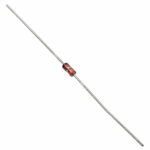 1N646/TR
The activity of extra discounts on wholesale prices is in full swing…
Please fill in your contact information and we will send you the latest wholesale price list.




