 ChipApex | Global Electronic Components Supplier
SEARCH
Search Product
Search Post
— IC芯片 | 连接器 | 传感器 | 被动器件 —
Search productSearch post
— IC芯片 | 连接器 | 传感器 | 被动器件 —
Consult the customer manager about the wholesale price.
consultation hotline:86-132-6715-2157
email:[email protected]
Contact the product manager for consultation. One-stop consultation is available.
Do you want a lower wholesale price? Please send us your inquiry and we will reply immediately.
The Renesas Electronics Corporation 2308-4DCG is a discontinued 3.3V Zero Delay Clock Multiplier IC designed for high-speed clock distribution and multiplication applications. It operates within a frequency range of 10 MHz to 133 MHz, utilizing a Phase-Lock Loop (PLL) to align the phase between the incoming clock and output clocks. The device features eight LVCMOS outputs organized into two banks of four, with separate enable controls for each bank. Key electrical parameters include an input voltage of 3.3 V, maximum cycle-to-cycle jitter of 200 ps, and output skew less than 200 ps. It is housed in a 16-pin SOIC package.
The 2308-4DCG is officially listed as obsolete or discontinued by the manufacturer. Verification of availability should focus on secondary market distributors or surplus inventory sources rather than standard supply channels. Users must confirm the specific manufacturing date code and RoHS compliance status, as legacy stock may vary from current environmental standards.
This component is specifically configured for a 1x multiplication ratio; other variants such as the 2308-2 or 2308-4 offer different prescaling options. Designers requiring spread spectrum compatibility should consider the 23S08 series instead. Ensure the application strictly adheres to the 3.3 V supply requirement and LVCMOS interface specifications before selecting this part.
The 2308-4DCG belongs to the IDT 2308 family of zero delay buffers, which are widely used for clock synchronization in telecommunications and computing infrastructure. This specific suffix indicates a 1x multiplier configuration packaged in a 16-pin SOIC format. The family allows for flexible PLL closure to control delay between input and output signals.
Direct functional replacements are limited due to the component's discontinued status. Potential alternatives include the 2308B-4 series for similar zero-delay buffering or the 23S08 series if spread spectrum support is required. Verify pinout compatibility and voltage levels when evaluating substitute parts.
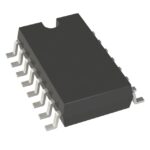 2308-4DCG
The activity of extra discounts on wholesale prices is in full swing…
Please fill in your contact information and we will send you the latest wholesale price list.






