 ChipApex | Global Electronic Components Supplier
SEARCH
Search Product
Search Post
— IC芯片 | 连接器 | 传感器 | 被动器件 —
Search productSearch post
— IC芯片 | 连接器 | 传感器 | 被动器件 —
Consult the customer manager about the wholesale price.
consultation hotline:86-132-6715-2157
email:[email protected]
Contact the product manager for consultation. One-stop consultation is available.
Do you want a lower wholesale price? Please send us your inquiry and we will reply immediately.
The 2308A-1DCGI is a 3.3V Zero Delay Clock Multiplier manufactured by Renesas Electronics Corporation, belonging to the 2308 family. It functions as a high-speed phase-lock loop (PLL) device designed for clock distribution and multiplication applications operating between 10MHz and 133MHz. The component features zero delay characteristics achieved by aligning the phase of the incoming clock with the output clock. It accepts one reference input and distributes it to two banks of four outputs each, totaling eight outputs. The device operates at a core voltage of 3.3V and is housed in a 16-pin SOIC package.
Verify current availability status as the 2308 series may be subject to discontinuation or lifecycle changes. Confirm moisture sensitivity level (MSL) and reflow soldering profiles prior to assembly. Ensure the specific -1 suffix configuration matches the required 1x multiplication factor. Check for RoHS compliance documentation corresponding to the manufacturing date code.
Select the 2308A-1DCGI when a single frequency multiplication ratio (1x) is required alongside low skew distribution. Compare against the 2308B series if industrial temperature ranges (-40°C to +85°C) are necessary, as the 'A' designation typically implies commercial range. Verify that the 16-pin SOIC footprint fits the PCB layout constraints compared to TSSOP alternatives.
The 2308A-1DCGI is part of the broader 2308/2308B family of zero delay clock multipliers from Integrated Device Technology (IDT), now under Renesas Electronics. This family includes variants with different multiplication factors (1x, 2x, 4x) and drive strengths (standard vs. high drive). The 'DCGI' suffix denotes the SOIC-16 package, commercial temperature range, and lead-free composition.
Direct substitutes include other members of the 2308 family such as IDT2308-1DCG or IDT2308-1DCGI. For industrial temperature requirements, consider the 2308B-1DCGI variant. Cross-reference with the 2309 series if buffering without multiplication is sufficient, noting the pinout compatibility differences.
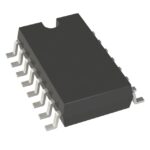 2308A-1DCGI
The activity of extra discounts on wholesale prices is in full swing…
Please fill in your contact information and we will send you the latest wholesale price list.





