 ChipApex | Global Electronic Components Supplier
SEARCH
Search Product
Search Post
— IC芯片 | 连接器 | 传感器 | 被动器件 —
Search productSearch post
— IC芯片 | 连接器 | 传感器 | 被动器件 —
Consult the customer manager about the wholesale price.
consultation hotline:86-132-6715-2157
email:[email protected]
Contact the product manager for consultation. One-stop consultation is available.
Do you want a lower wholesale price? Please send us your inquiry and we will reply immediately.
The Microchip Technology 25LC080DT-I/MS is an 8 Kbit Serial Electrically Erasable PROM featuring a 1024 x 8-bit organization. It utilizes a standard SPI-compatible serial bus with SCK, SI, SO, and CS signals for communication. The device supports a maximum clock frequency of 10 MHz and operates within a supply voltage range of 2.5 V to 5.5 V. It employs a 32-byte page write architecture and includes hardware write protection via the WP pin. The component is housed in an 8-lead MSOP package and is rated for industrial temperature operation from -40°C to +85°C.
Verify that the specific suffix 'DT' corresponds to the TDFN-8 package variant rather than the MSOP package indicated by '/MS'. Confirm the operating voltage range matches the application requirements, as the 'LC' series typically requires a minimum of 2.5 V. Ensure the industrial temperature grade meets environmental specifications.
Select this component when a 32-byte page size is required for efficient data writing compared to 16-byte alternatives. Consider the MSOP package dimensions for board space constraints. Verify compatibility with the host microcontroller's SPI voltage levels and clock speed capabilities before integration.
This part belongs to the 25XX080C/D family of 8 Kbit Serial EEPROMs. The 'LC' designation indicates a 2.5 V to 5.5 V operating voltage range, distinguishing it from the 'AA' series which supports lower voltages. The 'D' suffix specifies the 32-byte page write capability, whereas the 'C' version uses a 16-byte page size.
The 25LC080C-DT-I/MNY serves as a direct functional substitute within the same family, offering identical electrical characteristics and memory organization but utilizing a TDFN-8 package instead of the MSOP form factor.
The HOLD pin allows the user to suspend transmission mid-sequence without resetting the internal address pointer. Communication resumes automatically when the pin is returned high while the clock is low.
The WP pin works in conjunction with the WPEN bit in the STATUS register to disable writes to the nonvolatile bits in the STATUS register when held low, providing hardware-level protection against accidental configuration changes.
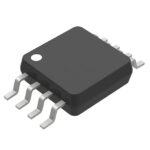 25LC080DT-I/MS
The activity of extra discounts on wholesale prices is in full swing…
Please fill in your contact information and we will send you the latest wholesale price list.





