 ChipApex | Global Electronic Components Supplier

SEARCH
Search Product
Search Post
Search productSearch post
Consult the customer manager about the wholesale price.
consultation hotline:86-132-6715-2157
email:[email protected]
Contact the product manager for consultation. One-stop consultation is available.
Do you want a lower wholesale price? Please send us your inquiry and we will reply immediately.
2862 is listed in the Imu Inertial Measurement Unit range at ChipApex. The manufacturer field lists Pololu. Its product description is MINIMU-9 V6 GYRO ACCEL & COMPASS. Review the specifications below when checking this part for your BOM.
Pololu part number 2862 identifies the Maestro 18-channel servo controller, a dedicated hardware unit designed for precise multi-axis motion management. The device features an integrated microcontroller that handles pulse-width modulation (PWM) signal generation internally, ensuring stable timing independent of host system load or operating system jitter. It provides eighteen output channels compatible with standard hobby servos and continuous rotation motors, accepting commands via serial communication interfaces including USB virtual COM ports and TTL-level UART. The controller supports advanced motion parameters such as target position, speed limits, and acceleration profiles within its binary protocol stack. This architecture allows a primary host processor to offload real-time motor control tasks, focusing instead on high-level kinematic calculations and sensor fusion algorithms.
Verify the specific product variant matches the required channel count and interface type before integration. Confirm that the power supply specifications align with the total current draw of all connected servos under maximum load conditions. Ensure the host system configuration supports the necessary serial communication protocols, particularly regarding baud rate settings and voltage level compatibility for TTL connections. Check for any firmware updates available from the manufacturer to maintain optimal performance and bug fixes. Review the mechanical mounting requirements to ensure proper physical integration into the target assembly without obstructing ventilation or access ports.
Choose this controller when the application requires more than four or six channels, making direct GPIO PWM generation impractical due to software latency and resource constraints. It is suitable for projects where deterministic motion timing is critical, such as dynamic balancing or high-speed tracking. Select this component if the development workflow involves Python or C++ scripts running on Linux-based single-board computers like BeagleY-AI or Raspberry Pi. It is ideal for separating computational logic from real-time actuation control, simplifying debugging by isolating motion errors from algorithmic errors.
The Maestro series represents Pololu's line of servo controllers designed to simplify robotics development by abstracting low-level timing details. Part 2862 specifically denotes the eighteen-channel variant, expanding upon the capabilities of smaller models like the 6-channel Micro Maestro. This model fits into the broader ecosystem of embedded motion control solutions, bridging the gap between simple microcontroller outputs and industrial-grade multi-axis drives. It is commonly paired with single-board computers to handle the heavy lifting of real-time signal generation while the host manages higher-order decision-making processes.
For applications requiring fewer channels, the Pololu Micro Maestro 6-channel controller may serve as a compact alternative. If higher channel counts are needed, consider the Pololu Maestro 24-channel controller. For projects requiring feedback loops beyond simple position control, integrating external encoders with a general-purpose microcontroller might be necessary instead of relying solely on servo feedback. Direct replacement with generic PWM generators is not recommended due to the loss of coordinated motion profiling and error handling capabilities.
Yes, the controller supports both standard positional servos and continuous rotation servos, allowing for differential drive configurations in mobile robots.
The controller can detect stall conditions through current monitoring and report errors via the serial interface, allowing the host software to halt motion or adjust trajectories.
The USB interface primarily handles data communication and configuration; external power supplies are typically required to drive the servos themselves based on their current demands.
Explore related parts through Motion Sensors, Sensors, Transducers, all product categories, ChipApex homepage.
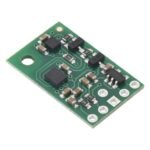 2862

The activity of extra discounts on wholesale prices is in full swing…
Please fill in your contact information and we will send you the latest wholesale price list.





