 ChipApex | Global Electronic Components Supplier
SEARCH
Search Product
Search Post
— IC芯片 | 连接器 | 传感器 | 被动器件 —
Search productSearch post
— IC芯片 | 连接器 | 传感器 | 被动器件 —
Consult the customer manager about the wholesale price.
consultation hotline:86-132-6715-2157
email:[email protected]
Contact the product manager for consultation. One-stop consultation is available.
Do you want a lower wholesale price? Please send us your inquiry and we will reply immediately.
The Vishay 2KBP005M is a glass-passivated single-phase bridge rectifier in the KBPM case style. It provides a maximum repetitive peak reverse voltage (VRRM) of 50 V and a maximum average forward output rectified current (IF(AV)) of 2.0 A at an ambient temperature of 55 °C. The device supports a peak forward surge current (IFSM) of 60 A for a single half-sine wave superimposed on rated load. Electrical characteristics include a maximum instantaneous forward voltage drop (VF) of 1.1 V per diode at 3.14 A, and a maximum DC reverse current (IR) of 5 µA at 25 °C. The operating junction and storage temperature range extends from -55 °C to +165 °C.
Verify component authenticity by checking the manufacturer's document number 88532 and revision date. Confirm compliance with RoHS 2002/95/EC and WEEE 2002/96/EC directives as specified in the datasheet. Ensure the ordering suffix matches the required package code and delivery mode for your specific assembly needs.
Select this component when a 50 V rating and 2 A continuous current are sufficient for the application. Consider the thermal resistance values (RθJA of 30 °C/W and RθJL of 11 °C/W) for heat dissipation planning. Verify that the PCB copper pad dimensions meet the recommended 12 x 12 mm size for optimal thermal performance.
This part belongs to the 2KBP series, which includes variants ranging from 50 V to 1000 V reverse voltage. The 2KBP005M specifically denotes the 50 V version within the KBPM case style family. Equivalent parts in the same series include the 3N253 through 3N259 designations.
Direct substitutes within the same voltage and current ratings include other 2KBP005M units or equivalent 3N253 components from Vishay. Ensure any replacement maintains the KBPM case style and glass passivation characteristics for compatibility.
The maximum non-repetitive peak forward surge current (IFSM) is 60 A for a single half-sine wave superimposed on rated load.
The typical junction capacitance (CJ) is 25 pF, measured at 4.0 V and 1 MHz.
Polarity is marked on the body of the case, with the positive lead identified by a beveled corner.
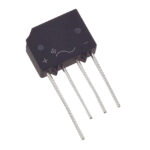 2KBP005M/1
The activity of extra discounts on wholesale prices is in full swing…
Please fill in your contact information and we will send you the latest wholesale price list.





