ChipApex | Global Electronic Components Supplier

SEARCH
Search Product
Search Post
— IC芯片 | 连接器 | 传感器 | 被动器件 —
Search productSearch post
— IC芯片 | 连接器 | 传感器 | 被动器件 —
Consult the customer manager about the wholesale price.
consultation hotline:86-132-6715-2157
email:[email protected]
Contact the product manager for consultation. One-stop consultation is available.
Do you want a lower wholesale price? Please send us your inquiry and we will reply immediately.
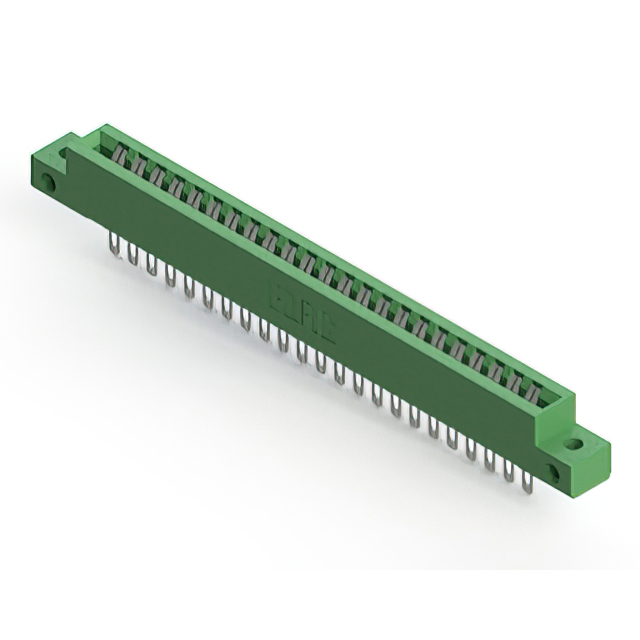
The EDAC Inc. 306-023-400-112 is a standard card edge connector from the 306 series, designed for reliable signal transmission in electronic assemblies. This receptacle features a dual female configuration with 46 positions arranged across two rows. It utilizes a 3.96 mm (0.156 inch) pitch to accommodate standard card edge boards. The contacts are constructed from copper alloy and finished with gold plating to ensure low contact resistance and durability. Rated for 5 A current, it supports operation within a temperature range of -55°C to +125°C. The housing is made of polyphenylene sulfide (PPS), providing high thermal stability and mechanical strength.
Verify that the specific part number matches the required 46-position dual row specification before procurement. Confirm that the operating environment temperature does not exceed the rated limits for the PPS housing material. Ensure that the card edge board thickness is compatible with the connector's design specifications to guarantee proper insertion force and electrical continuity during assembly.
Select this component when a dual-row card edge interface is necessary for space-constrained applications. The 3.96 mm pitch allows for higher density compared to larger pitch alternatives while maintaining sufficient spacing for insulation. Consider the 5 A current rating to ensure adequate power handling capabilities for the intended circuit loads without excessive heating or voltage drop issues.
This component belongs to the EDAC 306 series of standard card edge connectors, which are widely used in industrial and commercial electronics. The series is characterized by its vertical panel mount style and solder pin termination method. These connectors are engineered to provide secure mechanical retention and stable electrical connections for printed circuit boards inserted into the receptacle slots.
Direct substitutes may include other EDAC 306 series variants with matching position counts and pitch dimensions. Verify compatibility with existing PCB layouts and mounting hole patterns when considering alternative manufacturers. Ensure that any replacement maintains the same current rating and temperature specifications to preserve system reliability and safety margins.
 306-023-400-112

The activity of extra discounts on wholesale prices is in full swing…
Please fill in your contact information and we will send you the latest wholesale price list.