ChipApex | Global Electronic Components Supplier
SEARCH
Search Product
Search Post
— IC芯片 | 连接器 | 传感器 | 被动器件 —
Search productSearch post
— IC芯片 | 连接器 | 传感器 | 被动器件 —
Consult the customer manager about the wholesale price.
consultation hotline:86-132-6715-2157
email:[email protected]
Contact the product manager for consultation. One-stop consultation is available.
Do you want a lower wholesale price? Please send us your inquiry and we will reply immediately.
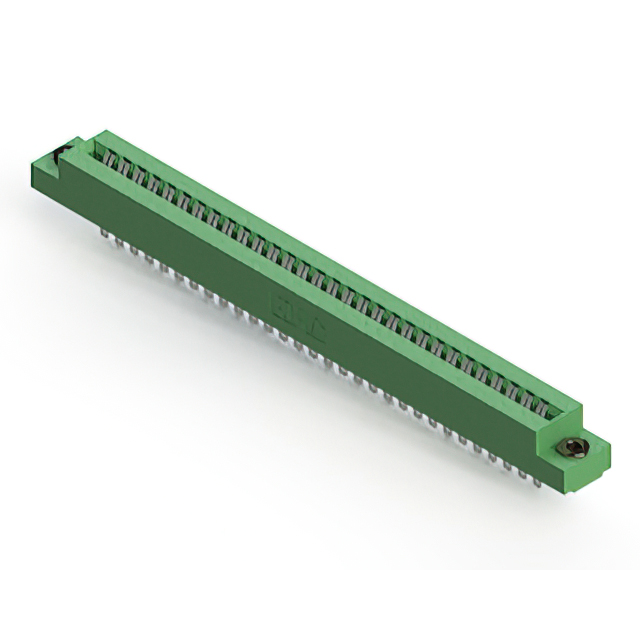
The EDAC Inc. 306-030-400-103 is a standard card edge connector receptacle featuring 60 positions arranged in a single row with a 3.96 mm (0.156 inch) pitch. Designed for vertical panel mount installation, it utilizes tin-plated copper alloy contacts and terminates via solder connections to accommodate board thicknesses of 1.57 mm. The housing is constructed from green thermoplastic material, providing an insulation resistance of 5 GOhms. It operates within a temperature range of -40°C to +105°C and supports a current rating of 5 A.
Verify the specific plating finish and contact termination method against the official manufacturer datasheet before procurement. Confirm that the supplier documentation explicitly lists the part number 306-030-400-103 as a genuine EDAC component. Ensure compatibility with the intended PCB thickness and mounting hole specifications to avoid mechanical integration issues during assembly.
Select this component when a single-row, 60-position interface is required with a 3.96 mm pitch. It is suitable for designs necessitating vertical panel mounting and solder terminations. Consider the operating temperature limits and current ratings to ensure they align with the system's electrical and thermal requirements. Verify that the thermoplastic housing material meets environmental standards for the target application.
This component belongs to the EDAC 306 series of standard card edge connectors. The series offers various configurations including different row counts, pitches, and termination styles. The 306 series is designed for general-purpose electronic applications where reliable signal transmission and secure mechanical connection are essential for board-to-panel or board-to-board interfaces.
Direct substitutes must match the 60-position count, 3.96 mm pitch, single-row layout, and vertical panel mount style. Verify that alternative components support the same 1.57 mm board thickness and solder termination type. Cross-reference insulation material properties and operating temperature ranges to ensure functional equivalence in the specific application environment.
 306-030-400-103
The activity of extra discounts on wholesale prices is in full swing…
Please fill in your contact information and we will send you the latest wholesale price list.