 ChipApex | Global Electronic Components Supplier
SEARCH
Search Product
Search Post
— IC芯片 | 连接器 | 传感器 | 被动器件 —
Search productSearch post
— IC芯片 | 连接器 | 传感器 | 被动器件 —
Consult the customer manager about the wholesale price.
consultation hotline:86-132-6715-2157
email:[email protected]
Contact the product manager for consultation. One-stop consultation is available.
Do you want a lower wholesale price? Please send us your inquiry and we will reply immediately.
The Schott Corporation 37544 is a surface-mount pulse transformer designed for T1 and E1 network applications. It features an octal configuration with a 1:2 center-tapped winding ratio, suitable for high-speed data transmission interfaces. The component is engineered to provide signal isolation and impedance matching in telecommunications equipment. Its compact SMD package facilitates automated assembly processes, ensuring consistent performance in digital communication systems requiring reliable signal integrity over twisted-pair cabling.
Verify the specific manufacturer datasheet for electrical tolerances and thermal characteristics before integration. Confirm that the surface-mount footprint matches the target PCB layout dimensions. Ensure compliance with relevant telecommunications safety standards for the intended deployment environment. Cross-reference part numbers to avoid confusion with similar octal transformers from other manufacturers.
Select this component when designing circuits for T1 or E1 physical layer interfaces requiring galvanic isolation. The 1:2 center-tapped configuration is critical for proper signal coupling in these specific digital standards. Consider the surface-mount form factor for space-constrained designs. Evaluate thermal management requirements based on the power dissipation limits specified in the official documentation.
This pulse transformer belongs to the family of components used in digital telecommunication infrastructure. It serves as a key passive element in converting and isolating signals between network lines and processing circuitry. The octal design allows for multiple windings within a single package, reducing board space compared to discrete transformer solutions.
Direct substitutes must match the T1/E1 specification, octal pinout, and 1:2CT ratio. Verify compatibility with existing driver and receiver ICs. Check if alternative suppliers offer equivalent magnetic specifications and mechanical dimensions to ensure seamless replacement without redesigning the PCB.
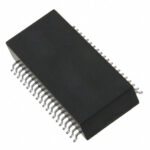 37544
37544
The activity of extra discounts on wholesale prices is in full swing…
Please fill in your contact information and we will send you the latest wholesale price list.





