 ChipApex | Global Electronic Components Supplier
SEARCH
Search Product
Search Post
— IC芯片 | 连接器 | 传感器 | 被动器件 —
Search productSearch post
— IC芯片 | 连接器 | 传感器 | 被动器件 —
Consult the customer manager about the wholesale price.
consultation hotline:86-132-6715-2157
email:[email protected]
Contact the product manager for consultation. One-stop consultation is available.
Do you want a lower wholesale price? Please send us your inquiry and we will reply immediately.
The CD40193BDC is a synchronous 4-bit up/down decade counter manufactured by National Semiconductor. It is a monolithic complementary MOS (CMOS) integrated circuit designed for binary counting operations. The device features dual clock inputs to manage counting up and down independently, with outputs changing on the positive-going transition of the active clock signal. It includes asynchronous clear functionality and dedicated carry and borrow outputs to facilitate cascading for expansion to N-bit configurations.
Verify the manufacturer origin carefully, as National Semiconductor was acquired by Texas Instruments. Ensure the specific suffix 'DC' matches the required package type and temperature rating from the official datasheet. Confirm that the component meets current RoHS compliance standards if required for your assembly process. Cross-reference the part number with Texas Instruments documentation to ensure accurate pinout and electrical specifications are applied during design.
Select this component when a synchronous CMOS counter with dual clock inputs is required for binary counting. It is suitable for designs needing low power consumption and high noise immunity within a wide supply voltage range. Consider its compatibility with TTL logic levels if interfacing with older digital systems. Verify that the package style and operating temperature range meet the specific environmental constraints of the target application.
The CD40193 series belongs to the standard 4000-series CMOS logic family. These counters are widely used in general-purpose digital electronics due to their versatility and ease of use. The device is functionally equivalent to other manufacturers' parts like the MM74C193, allowing for flexible sourcing options while maintaining consistent performance characteristics across different production batches.
Counting up and down is performed using two separate count inputs. One input must be held HIGH while the other is clocked to determine the direction of the count.
These outputs allow for easy expansion to N-bit counters by cascading multiple devices together, enabling more complex counting sequences beyond the 4-bit limit.
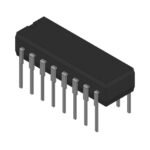 40193BDC
The activity of extra discounts on wholesale prices is in full swing…
Please fill in your contact information and we will send you the latest wholesale price list.





