ChipApex | Global Electronic Components Supplier

SEARCH
Search Product
Search Post
— IC芯片 | 连接器 | 传感器 | 被动器件 —
Search productSearch post
— IC芯片 | 连接器 | 传感器 | 被动器件 —
Consult the customer manager about the wholesale price.
consultation hotline:86-132-6715-2157
email:[email protected]
Contact the product manager for consultation. One-stop consultation is available.
Do you want a lower wholesale price? Please send us your inquiry and we will reply immediately.
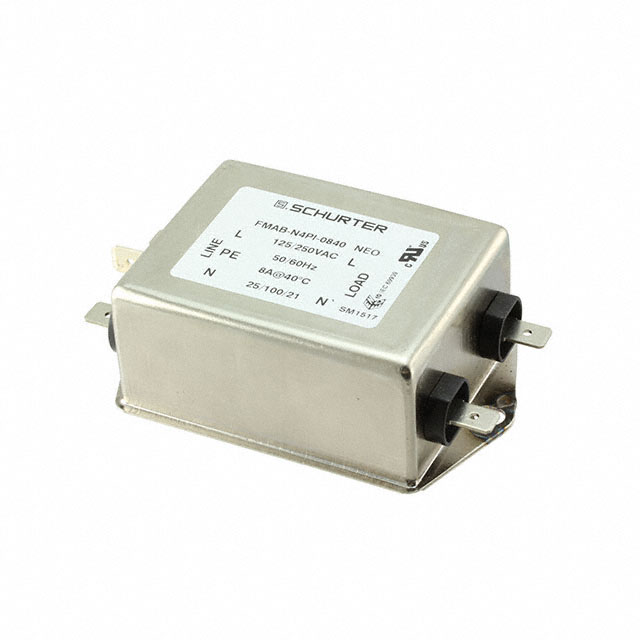
SCHURTER Inc. model 5500.2634.01 is a single-phase power line filter from the FMBB NEO series, designed for chassis mounting with screw terminals and quick connect options. It operates at a maximum voltage of 250V AC and supports a continuous current of 8A at 50Hz or 60Hz frequencies. The unit features a compact design with dimensions of 64mm length, 35.5mm depth, and 24.8mm height. It includes a low resistance value of 12mΩ and a power loss of 0.86W. The filter is rated for a minimum operating temperature of -40°C and a maximum of 100°C, with a leakage current specification of 500μA.
Verify that the specific order matches the exact part number 5500.2634.01 to ensure correct current rating and mounting style. Confirm that the application environment stays within the specified -40°C to 100°C operating temperature range. Ensure the system voltage does not exceed 250V AC. Check for required certifications such as UL or CUL if applicable to the final product deployment. Validate that the 8A continuous current rating meets the load requirements without derating issues.
Select this component when a single-phase EMI filter is required for chassis-mounted applications. The 8A rating suits moderate power loads compared to higher current alternatives. The combination of screw and quick connect terminals offers installation flexibility. Consider the compact physical dimensions against available panel space. Verify medical compliance needs against the stated certification status.
This component belongs to the SCHURTER FMBB NEO series of power line filters. The series focuses on providing effective electromagnetic interference suppression in a small form factor. It is part of SCHURTER's broader portfolio of circuit protection and filtering solutions for industrial and medical markets. The design emphasizes reliability and ease of integration into existing power architectures.
Direct substitutes include other SCHURTER models within the same FMBB NEO series with matching 8A ratings and 250VAC specifications. Cross-reference dimensions and terminal types to ensure mechanical compatibility. Verify that alternative parts meet the same leakage current and temperature ratings.
 5500.2634.01

The activity of extra discounts on wholesale prices is in full swing…
Please fill in your contact information and we will send you the latest wholesale price list.