ChipApex | Global Electronic Components Supplier
SEARCH
Search Product
Search Post
— IC芯片 | 连接器 | 传感器 | 被动器件 —
Search productSearch post
— IC芯片 | 连接器 | 传感器 | 被动器件 —
Consult the customer manager about the wholesale price.
consultation hotline:86-132-6715-2157
email:[email protected]
Contact the product manager for consultation. One-stop consultation is available.
Do you want a lower wholesale price? Please send us your inquiry and we will reply immediately.
The AD625 is a precision programmable gain instrumentation amplifier manufactured by Analog Devices Inc. The 5962-8771901EA variant operates over an extended temperature range of -55°C to +125°C and utilizes a 16-Lead Ceramic DIP package. It supports user-programmable gains from 1 to 10,000 via three external resistors. Key electrical specifications include a maximum gain error of 0.02%, a gain temperature coefficient of 5 ppm/°C, and a low input offset voltage of 25 µV. The device features a 25 MHz gain bandwidth product, 4 nV/√Hz input voltage noise at 1 kHz, and a 5 V/µs slew rate.
Verify the specific military drawing availability and ensure the component matches the 16-Lead Ceramic DIP package specification. Confirm that the extended temperature grade (-55°C to +125°C) aligns with the system's thermal requirements. Cross-reference the part number against current manufacturer documentation to validate production status and compliance with relevant standards.
Select this component when fixed or programmable gains up to 10,000 are required with minimal external resistor dependency on performance. Consider the independent offset nulling capabilities for applications demanding high accuracy across varying temperatures. Ensure the supply voltage range and output swing requirements fit within the specified ±18 V limits and ±10 V output capability.
This part belongs to the AD625 family of precision instrumentation amplifiers designed for cost-effective, high-performance signal conditioning. The family includes various grades (A, B, C, J, K, S) covering commercial, industrial, and extended temperature ranges. The 5962-8771901EA designation indicates a specific military-grade version within this lineage, offering robust performance in harsh environments.
Direct substitutes include other AD625 variants such as AD625SD or AD625SE/883B for similar extended temperature operation. Verify pin compatibility and package dimensions when replacing with ceramic DIP options. Ensure any alternative maintains the required gain range and offset nulling functionality.
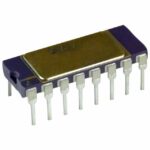 5962-8771901EA
The activity of extra discounts on wholesale prices is in full swing…
Please fill in your contact information and we will send you the latest wholesale price list.