 ChipApex | Global Electronic Components Supplier
SEARCH
Search Product
Search Post
— IC芯片 | 连接器 | 传感器 | 被动器件 —
Search productSearch post
— IC芯片 | 连接器 | 传感器 | 被动器件 —
Consult the customer manager about the wholesale price.
consultation hotline:86-132-6715-2157
email:[email protected]
Contact the product manager for consultation. One-stop consultation is available.
Do you want a lower wholesale price? Please send us your inquiry and we will reply immediately.
The AD602 is a dual-channel, low-noise, wideband variable gain amplifier optimized for ultrasound imaging and precision signal processing. It features an X-AMP architecture with a linear-in-dB gain response controlled by a differential voltage interface. The device offers a gain range of -10 dB to +30 dB per channel, with a nominal bandwidth of 35 MHz independent of gain settings. Key specifications include a 1.4 nV/√Hz input noise spectral density, ±0.3 dB absolute gain accuracy, and stable group delay within ±2 ns. It supports signal gating and operates on ±5 V supplies.
Verify the specific grade suffix (J, A, or S) required for the target operating temperature range and environmental compliance. Confirm package availability, as military-grade variants may be restricted to CERDIP packaging. Ensure ordering documentation references the correct DESC part number for defense procurement requirements.
Select the AD602 over the AD600 when a lower maximum gain improves output signal-to-noise ratio. Verify that the required gain range fits within the -10 dB to +30 dB span. Consider the sequential or parallel cascading modes if an 80 dB total gain range is necessary for the application design.
This component belongs to the Analog Devices AD600/AD602 family of dual-channel variable gain amplifiers. The AD602 variant is specifically characterized for a reduced maximum gain compared to the AD600, which optimizes the signal-to-noise ratio at the output while maintaining identical noise density and bandwidth characteristics across the series.
Official substitute part numbers include AD600S and AD602S under DESC SMD 5962-94572 standards. Verify pin compatibility and thermal resistance differences when replacing standard commercial grades with military-grade CERDIP packages.
The gain in decibels is calculated using the formula: Gain (dB) = 32 VG + 10, where VG is the differential control voltage in volts.
The input resistance is nominally 100 Ω, laser trimmed to ±2%.
No, the -3 dB bandwidth is nominally 35 MHz and is essentially independent of the gain setting.
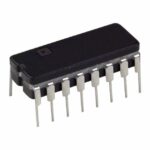 5962-9457201MEA
The activity of extra discounts on wholesale prices is in full swing…
Please fill in your contact information and we will send you the latest wholesale price list.






