 ChipApex | Global Electronic Components Supplier
SEARCH
Search Product
Search Post
— IC芯片 | 连接器 | 传感器 | 被动器件 —
Search productSearch post
— IC芯片 | 连接器 | 传感器 | 被动器件 —
Consult the customer manager about the wholesale price.
consultation hotline:86-132-6715-2157
email:[email protected]
Contact the product manager for consultation. One-stop consultation is available.
Do you want a lower wholesale price? Please send us your inquiry and we will reply immediately.
The Analog Devices / Maxim Integrated 73M1903-IVT/F is a modem analog front end (AFE) IC designed for PSTN communications. It features fully differential hybrid driver outputs and receive pins, enabling high-performance hybrid circuits compatible with standard transformers. The device supports programmable sample rates from 7.2 kHz to 14.4 kHz, accommodating soft modem and DSP implementations up to V.92 (56 kbps). It operates on a 3.0 V to 3.6 V supply with 5 V tolerant I/O and includes an input reference frequency circuit accepting crystals from 9-27 MHz or external clocks between 9-40 MHz.
Verify the specific suffix IVT/F against the manufacturer's current ordering information to confirm package type and compliance status. Check for product discontinuance notices or limited availability status prior to procurement planning. Ensure the host system supports the required serial interface timing and voltage levels.
Select this component for applications requiring a complete modem AFE solution with integrated hybrid drivers. Ensure the design accommodates the 3.0 V to 3.6 V operating range and utilizes separate decoupling for VPA and VPD supplies. Verify that the host processor can generate the necessary frame synchronization and serial clock signals within the specified timing constraints.
The 73M1903 is part of the Teridian/Maxim modem AFE family, pin-compatible with the 73M2901CL/CE series. It is available in 32-pin QFN and 20-pin TSSOP packages. The device integrates analog sigma-delta modulation, control registers, and a DAC, simplifying system integration for voice band communication terminals.
The datasheet notes pin compatibility with the 73M2901CL/CE modems. Verify functional equivalence and register map compatibility before substitution. No other direct replacement part numbers are explicitly listed in the provided documentation.
The device supports programmable sample rates from 7.2 kHz to 14.4 kHz by programming the pre-scaler NCO and PLL NCO.
It accepts a range of crystals from 9-27 MHz or external reference clock values between 9-40 MHz generated by the host processor, eliminating the need for a dedicated crystal oscillator in many applications.
The device operates between 3.0 V and 3.6 V. It has separate positive digital supply (VPD) and positive analog supply (VPA) pins that should be decoupled separately to isolate digital noise.
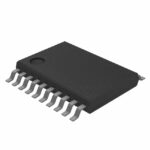 73M1903-IVT/F
The activity of extra discounts on wholesale prices is in full swing…
Please fill in your contact information and we will send you the latest wholesale price list.





