 ChipApex | Global Electronic Components Supplier
SEARCH
Search Product
Search Post
— IC芯片 | 连接器 | 传感器 | 被动器件 —
Search productSearch post
— IC芯片 | 连接器 | 传感器 | 被动器件 —
Consult the customer manager about the wholesale price.
consultation hotline:86-132-6715-2157
email:[email protected]
Contact the product manager for consultation. One-stop consultation is available.
Do you want a lower wholesale price? Please send us your inquiry and we will reply immediately.
The 73M1906B-IVTR/F is a Host-Side Data Access Arrangement (DAA) component within the 73M1x66B MicroDAA family, designed for Voice-over-IP applications. It provides digital data, control interfaces, and power to the paired Line-Side Device via a small pulse transformer isolation barrier. The device features an 8-kHz sampling rate with ITU-T G.711 compliant codec support in selectable μ-law and A-law companding modes, alongside a 16-bit linear mode suitable for wideband codecs at 16 kHz. Operating voltage ranges from 3.0 V to 3.6 V, supporting industrial temperatures from -40 °C to +85 °C. It offers up to +6 dB analog gain on the transmit path and +3 dB on the receive path, with adjustable digital gain from –18 dB to +7.375 dB in 0.125 dB increments.
Verify that the specific suffix 'IVTR/F' corresponds to the required package type and temperature grade as defined in the manufacturer's ordering information. Confirm that the host system design accommodates the necessary isolation barrier components and supports the SPI control interface requirements specified in the datasheet.
Select this component when designing FXO interfaces requiring a split DAA architecture between host and line sides. Ensure the application requires the specific isolation capabilities and PCM highway integration provided by the 73M1x66B family. Verify compatibility with the paired 73M1916 Line-Side Device for proper power and data transfer across the isolation barrier.
The 73M1906B serves as the host-side controller in the 73M1x66B MicroDAA family. It functions exclusively in conjunction with the 73M1916 Line-Side Device to provide complete PSTN connectivity. This split architecture allows for flexible system integration while maintaining high reliability and global compliance through the shared patented technology.
Publicly confirmed substitute part numbers are not available in the provided documentation. Designers should consult the manufacturer for current alternatives or verify if other members of the 73M1x66B family meet the specific functional requirements.
It acts as the Host-Side Device, providing digital data, control interfaces, and power to the Line-Side Device (73M1916) via a pulse transformer isolation barrier.
Yes, it includes an ITU-T G.711 compliant codec with selectable μ-law and A-law companding modes, as well as a 16-bit linear mode.
Power is transferred to the Line-Side Device across the isolation barrier using a small pulse transformer, ensuring reliable operation in the presence of EMI and line voltage variations.
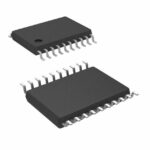 73M1906B-IVTR/F
The activity of extra discounts on wholesale prices is in full swing…
Please fill in your contact information and we will send you the latest wholesale price list.






