 ChipApex | Global Electronic Components Supplier
SEARCH
Search Product
Search Post
— IC芯片 | 连接器 | 传感器 | 被动器件 —
Search productSearch post
— IC芯片 | 连接器 | 传感器 | 被动器件 —
Consult the customer manager about the wholesale price.
consultation hotline:86-132-6715-2157
email:[email protected]
Contact the product manager for consultation. One-stop consultation is available.
Do you want a lower wholesale price? Please send us your inquiry and we will reply immediately.
The onsemi 74ACT818SPC is an 8-bit diagnostic register housed in a 24-lead Plastic Dual-In-Line (PDIP) package. It operates within a supply voltage range of 4.5V to 5.5V and supports an operating temperature from -40°C to +85°C. The device features edge-triggered D registers with TTL-compatible inputs, capable of sourcing or sinking 24 mA. Propagation delays for the pipeline clock to output range from 2.5 ns to 10.0 ns under standard loading conditions.
Verify that the specific ordering code matches the required 24-lead PDIP package configuration. Confirm that the component meets the specified ACT logic family requirements for your system design. Ensure compatibility with existing pinouts if replacing legacy components such as the AMD Am29818 or MMI 74S818. Check current availability status as this part originates from historical manufacturing lines.
Select this component when high-speed 8-bit latching with integrated diagnostic capabilities is required. It is suitable for systems needing simultaneous parallel data transfer and serial shift operations via independent clocks. Consider its functional equivalence to older ACT devices if maintaining backward compatibility with established hardware architectures is necessary.
This component belongs to the 74ACT logic family, designed for high-speed digital applications requiring TTL-compatible inputs. The 74ACT818 series specifically addresses needs for complex control logic where internal state monitoring and serial test routines are essential for system maintenance and verification.
Functionally and pin-compatible with AMD Am29818 and MMI 74S818.
The diagnostic register can load parallel data from the Y-port or adjacent bits to operate as a right-shift register. It can also swap contents with the output register or load the pipeline register from its own output based on the MODE input state.
The MODE control input determines whether the pipeline register loads data from the primary data inputs (D0-D7) or from the output of the diagnostic register during the PCLK transition.
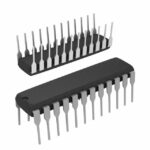 74ACT818SPC
The activity of extra discounts on wholesale prices is in full swing…
Please fill in your contact information and we will send you the latest wholesale price list.






