 ChipApex | Global Electronic Components Supplier
SEARCH
Search Product
Search Post
— IC芯片 | 连接器 | 传感器 | 被动器件 —
Search productSearch post
— IC芯片 | 连接器 | 传感器 | 被动器件 —
Consult the customer manager about the wholesale price.
consultation hotline:86-132-6715-2157
email:[email protected]
Contact the product manager for consultation. One-stop consultation is available.
Do you want a lower wholesale price? Please send us your inquiry and we will reply immediately.
The 74AHCT1G126QW5-7 is a single non-inverting buffer with 3-state output, designed for automotive applications. It operates within a supply voltage range of 4.5V to 5.5V and supports Grade 1 ambient temperature operation from -40°C to +125°C. The device provides ±8mA output drive at 5.0V and features Schmitt trigger inputs for tolerance to slower input rise and fall times. Propagation delay (tPD) ranges from 1.0ns to 9.5ns depending on load capacitance and temperature. It includes ESD protection exceeding 2000V HBM and 1000V CDM per AEC-Q100 standards.
Verify the specific package variant required, as the Q suffix denotes AEC-Q100 qualification while W5 indicates SOT25 packaging. Confirm that the application environment strictly adheres to the specified operating voltage and temperature limits. Ensure proper handling procedures are followed due to the sensitivity of CMOS inputs. Check for any specific change control requirements mandated by the end-use industry standards.
Select this component when an automotive-grade, single-channel buffer with 3-state output is needed. It is suitable for designs requiring high noise immunity via Schmitt triggers and robust ESD protection. Consider the propagation delay characteristics relative to the system clock speed and load capacitance. Ensure the power supply remains within the 4.5V to 5.5V range for optimal performance.
This part belongs to the 74AHCT logic family, which ensures compatibility with standard TTL inputs while operating at CMOS speeds. The '1G' designation indicates a single gate configuration in a compact surface-mount package. The 'Q' suffix specifically identifies it as an automotive-qualified product manufactured in IATF 16949 certified facilities, distinguishing it from commercial grade counterparts.
74AHCT1G126SE-7
The OE (Output Enable) pin controls the output state. When OE is HIGH, the buffer functions normally. When OE is LOW, the output enters a high impedance state.
Yes, the 74AHCT1G126QW5-7 features Schmitt trigger action at all inputs, making the circuit tolerant for slower input rise and fall times.
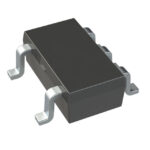 74AHCT1G126QW5-7
The activity of extra discounts on wholesale prices is in full swing…
Please fill in your contact information and we will send you the latest wholesale price list.





