 ChipApex | Global Electronic Components Supplier
SEARCH
Search Product
Search Post
— IC芯片 | 连接器 | 传感器 | 被动器件 —
Search productSearch post
— IC芯片 | 连接器 | 传感器 | 被动器件 —
Consult the customer manager about the wholesale price.
consultation hotline:86-132-6715-2157
email:[email protected]
Contact the product manager for consultation. One-stop consultation is available.
Do you want a lower wholesale price? Please send us your inquiry and we will reply immediately.
The 74ALVC16334ADGG:11 is a 16-bit registered driver with inverted register enable and 3-state outputs, housed in a 48-pin TSSOP package. It operates within a supply voltage range of 1.2 V to 3.6 V. At 3.0 V, it provides current drive of ±24 mA and supports propagation delays as low as 2.3 ns with a maximum clock frequency of 350 MHz at 3.3 V. The device features low power consumption, direct TTL level interface capability, and compliance with JEDEC standard no. 8-1A.
Verify the specific ordering code 74ALVC16334ADGG:11 against the manufacturer's latest documentation to ensure compatibility with required temperature ranges and package types. Confirm that the 48-pin TSSOP form factor matches the target PCB footprint. Ensure design specifications align with the recommended operating conditions provided in the official datasheet before finalizing procurement decisions.
Select this component when a 16-bit registered driver with 3-state outputs is required for high-speed data bus applications. Consider the 1.2 V to 3.6 V supply range for flexibility in low-voltage systems. Evaluate the ±24 mA drive capability at 3.0 V for driving 50 Ω transmission lines. Verify that the TSSOP48 package fits the available board space and thermal requirements.
This part belongs to the 74ALVC16334A family of 16-bit registered drivers originally specified by Philips Semiconductors. The 'DGG' suffix indicates the 48-pin Plastic Thin Shrink Small Outline (TSSOP) Type II package. The ':11' suffix denotes a specific reel or tape configuration for automated assembly. The device replaces earlier versions of the 74ALVC16334 specification.
Check for updated revisions of the 74ALVC16334A series which may have superseded the original Philips specification. Verify pinout compatibility if substituting with equivalent parts from other manufacturers offering 16-bit registered drivers in TSSOP48 packages.
To ensure the high-impedance state during power up or power down, the OE input should be tied to VCC through a pullup resistor.
The minimum value of the resistor is determined by the current-sinking capability of the driver.
No, the operation of the OE input does not affect the state of the latch/flip-flop.
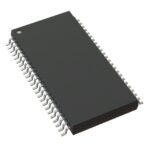 74ALVC16334ADGG:11
The activity of extra discounts on wholesale prices is in full swing…
Please fill in your contact information and we will send you the latest wholesale price list.





