 ChipApex | Global Electronic Components Supplier

SEARCH
Search Product
Search Post
— IC芯片 | 连接器 | 传感器 | 被动器件 —
Search productSearch post
— IC芯片 | 连接器 | 传感器 | 被动器件 —
Consult the customer manager about the wholesale price.
consultation hotline:86-132-6715-2157
email:[email protected]
Contact the product manager for consultation. One-stop consultation is available.
Do you want a lower wholesale price? Please send us your inquiry and we will reply immediately.
The 74ALVCH16843DGG,118 is an 18-bit bus-interface D-type latch manufactured by Nexperia. It features two independent 9-bit registers with separate inputs and 3-state outputs for bus-oriented applications. The device operates within a supply voltage range of 2.3 V to 3.6 V and supports data rates up to 5 Mbps in the CAN FD fast phase context. It includes active bus hold circuitry to maintain valid logic levels on floating inputs without external resistors.
Verify the specific ordering suffix (e.g., 118) against the manufacturer's current catalog to ensure correct packaging and tape-and-reel specifications. Confirm that the TSSOP56 package variant matches the required board layout dimensions. Check for any recent product change notices regarding pin compatibility or electrical parameter updates before finalizing procurement orders.
Select this component for designs requiring wide voltage operation between 2.3 V and 3.6 V with direct TTL level interfacing capabilities. Ensure the application benefits from the MULTIBYTE flow-through architecture and low inductance power pins for noise reduction. Verify that the ±24 mA drive capability meets the load requirements for connected transmission lines or buses.
This part belongs to the 74ALVCH series of advanced CMOS logic devices, designed for high-speed bus interfaces. It is produced by Nexperia, formerly known as NXP Semiconductors' standard products division. The device utilizes a plastic thin shrink small outline package with 56 leads, optimized for surface-mount technology in compact electronic assemblies.
The 74ALVCH16843DGGY is listed as a direct substitute for the 74ALVCH16843DGG,118 variant. Both parts share identical functional specifications and pinouts. Verify package availability and lead times when considering this alternative source.
The active bus hold circuitry holds unused or floating data inputs at a valid logic level, which eliminates the need for external pull-up or pull-down resistors.
Operation of the nOE (output enable) input does not affect the internal state of the flip-flops; it only controls whether the data appears at the outputs or enters a high-impedance OFF state.
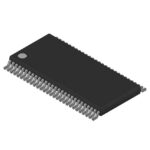 74ALVCH16843DGG118

The activity of extra discounts on wholesale prices is in full swing…
Please fill in your contact information and we will send you the latest wholesale price list.







