 ChipApex | Global Electronic Components Supplier
SEARCH
Search Product
Search Post
— IC芯片 | 连接器 | 传感器 | 被动器件 —
Search productSearch post
— IC芯片 | 连接器 | 传感器 | 被动器件 —
Consult the customer manager about the wholesale price.
consultation hotline:86-132-6715-2157
email:[email protected]
Contact the product manager for consultation. One-stop consultation is available.
Do you want a lower wholesale price? Please send us your inquiry and we will reply immediately.
The onsemi 74ALVCR162601T is an 18-bit universal bus transceiver housed in a 56-lead Thin Shrink Small Outline Package (TSSOP). It operates with a supply voltage range of 1.65V to 3.6V and features 3.6V tolerant inputs and outputs. The device integrates D-type latches and flip-flops for transparent, latched, or clocked data flow modes. Internal 26Ω series resistors are included on both A and B port outputs to reduce line noise. Propagation delays vary from 4.3 ns at 3.0V–3.6V to 9.2 ns at 1.65V–1.95V.
Verify the specific package suffix 'T' corresponds to the 56-lead TSSOP configuration as documented in the datasheet. Confirm that the component meets the required operating temperature range of -40°C to +85°C for your specific application environment. Ensure input signals remain within the specified DC voltage limits to prevent damage.
Select this component when designing low-voltage systems requiring 18-bit bidirectional data transfer with integrated termination resistance. It is suitable for interfaces needing 3.6V tolerance while operating at lower core voltages. Consider the propagation delay specifications relative to your system clock frequency requirements.
This device belongs to the 74ALVC logic family, designed for low-voltage CMOS applications. It combines the speed of ALV technology with the versatility of VCX features, such as 3.6V tolerance. The inclusion of series resistors distinguishes it from standard bus transceivers by offering built-in noise reduction capabilities without external components.
Check for direct pin-compatible alternatives within the same logic family that may offer updated manufacturing sources. Verify that any substitute maintains the 56-lead TSSOP footprint and identical electrical characteristics regarding voltage tolerance and propagation delay.
Data flow direction is controlled by separate Output Enable (OEAB/OEBA), Latch Enable (LEAB/LEBA), and Clock (CLKAB/CLKBA) inputs for each direction independently.
The 26 ohm series resistors are integrated into the output paths to reduce line noise, signal reflections, and electromagnetic interference in high-speed digital circuits.
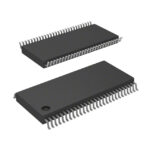 74ALVCR162601T
The activity of extra discounts on wholesale prices is in full swing…
Please fill in your contact information and we will send you the latest wholesale price list.







