 ChipApex | Global Electronic Components Supplier
SEARCH
Search Product
Search Post
— IC芯片 | 连接器 | 传感器 | 被动器件 —
Search productSearch post
— IC芯片 | 连接器 | 传感器 | 被动器件 —
Consult the customer manager about the wholesale price.
consultation hotline:86-132-6715-2157
email:[email protected]
Contact the product manager for consultation. One-stop consultation is available.
Do you want a lower wholesale price? Please send us your inquiry and we will reply immediately.
The Nexperia 74AVC4T774GU-Q100Z is a 4-bit dual supply translating transceiver with 3-state outputs, designed for bidirectional level translation. It features eight 1-bit input-output ports (An and Bn), four direction control inputs (DIR1–DIR4), and an output enable input (OE). Both VCC(A) and VCC(B) operate between 0.8 V and 3.6 V, supporting translations among low voltage nodes including 0.8 V, 1.2 V, 1.5 V, 1.8 V, 2.5 V, and 3.3 V. The device supports maximum data rates up to 380 Mbit/s depending on voltage levels. It includes IOFF circuitry for partial power-down applications and is qualified to AEC-Q100 Grade 1 standards.
Verify the specific ordering suffix 'Z' against official Nexperia documentation to confirm tape and reel packaging details, as datasheets may list standard reels. Confirm the XQFN16 package type (SOT1161-1) matches design requirements. Ensure AEC-Q100 Grade 1 qualification aligns with target automotive application specifications before finalizing procurement.
Select this component when bidirectional level translation is required between disparate low-voltage logic domains within the 0.8 V to 3.6 V range. The individual DIRn pins allow flexible per-channel direction control, unlike fixed-direction translators. Consider the extremely thin XQFN16 package for space-constrained PCB layouts. Verify that the 380 Mbit/s maximum data rate meets system timing requirements at the intended operating voltages.
This part belongs to the 74AVC4T774-Q100 family of 4-bit dual supply translating transceivers. The GU variant specifically utilizes the XQFN16 plastic package (SOT1161-1), distinguishing it from the DHVQFN16 (BQ) package version. It is part of Nexperia's automotive-grade logic portfolio, designed for high reliability in harsh environments.
The 74AVC4T774BQ-Q100 serves as a functional equivalent using the DHVQFN16 package. Verify pinout compatibility and thermal dissipation characteristics, as the XQFN16 package has different power dissipation limits compared to other variants.
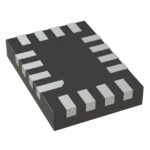 74AVC4T774GU-Q100Z
The activity of extra discounts on wholesale prices is in full swing…
Please fill in your contact information and we will send you the latest wholesale price list.






