 ChipApex | Global Electronic Components Supplier
SEARCH
Search Product
Search Post
— IC芯片 | 连接器 | 传感器 | 被动器件 —
Search productSearch post
— IC芯片 | 连接器 | 传感器 | 被动器件 —
Consult the customer manager about the wholesale price.
consultation hotline:86-132-6715-2157
email:[email protected]
Contact the product manager for consultation. One-stop consultation is available.
Do you want a lower wholesale price? Please send us your inquiry and we will reply immediately.
The Nexperia 74AVC9112GTX is a 1-to-4 fan-out buffer designed for clock distribution applications. It features a single data input (A), four non-inverting outputs (Yn), and an active-low output enable input (OE). The device operates on a single supply voltage ranging from 0.8 V to 3.6 V. Key electrical characteristics include a maximum data rate of 380 Mbit/s at 3.3 V, propagation delay of 4.4 ns at 3.3 V, and low static current consumption. It incorporates Schmitt trigger inputs for noise tolerance and IOFF circuitry to prevent backflow currents during power-down states.
Verify the ordering suffix 'GTX' corresponds to the XSON8 package (SOT833-1) and tape-and-reel delivery format. Confirm the temperature grade is -40 °C to +125 °C as specified for this variant. Ensure compatibility with JEDEC standards JESD8-12 through JESD8-B based on the selected operating voltage.
Select the 74AVC9112GTX when a compact XSON8 footprint is required compared to the VSSOP8 alternative. Evaluate the maximum data rate requirements against the supply voltage; speeds decrease to 100 Mbit/s at 1.2 V. Consider the 50 kΩ internal pull-down resistance on outputs when OE is HIGH, which forces outputs LOW.
The 74AVC9112GTX belongs to the Nexperia AVC logic family, characterized by ultra-low voltage operation and high speed. It is functionally equivalent to the 74AVC9112DC but utilizes the leadless XSON8 package (SOT833-1) instead of the VSSOP8 (SOT765-1). Both variants share identical electrical specifications and pinouts.
The 74AVC9112DC serves as a direct functional replacement if the application can accommodate the larger VSSOP8 package. No other part numbers are confirmed as electrically identical substitutes in the provided documentation.
The OE pin is active-low. A LOW signal enables the outputs, while a HIGH signal disconnects the outputs and activates internal pull-down resistors to force all outputs LOW.
The maximum data rates are 380 Mbit/s at 3.3 V, 200 Mbit/s at 2.5 V and 1.8 V, 150 Mbit/s at 1.5 V, and 100 Mbit/s at 1.2 V.
Yes, the inputs accept voltages up to 3.6 V regardless of the VCC supply level (0.8 V to 3.6 V), allowing it to translate signals between different low-voltage domains.
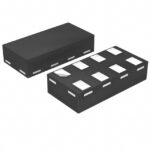 74AVC9112GTX
The activity of extra discounts on wholesale prices is in full swing…
Please fill in your contact information and we will send you the latest wholesale price list.





