 ChipApex | Global Electronic Components Supplier
SEARCH
Search Product
Search Post
— IC芯片 | 连接器 | 传感器 | 被动器件 —
Search productSearch post
— IC芯片 | 连接器 | 传感器 | 被动器件 —
Consult the customer manager about the wholesale price.
consultation hotline:86-132-6715-2157
email:[email protected]
Contact the product manager for consultation. One-stop consultation is available.
Do you want a lower wholesale price? Please send us your inquiry and we will reply immediately.
The SN74AVCH4T245-Q1 is an automotive-grade, 4-bit noninverting bus transceiver featuring configurable dual-supply voltage translation and 3-state outputs. It supports a power supply range of 1.08V to 3.6V on both ports (VCCA and VCCB), enabling universal bidirectional translation between standard low-voltage nodes such as 1.2V, 1.5V, 1.8V, 2.5V, and 3.3V. The device accommodates data rates up to 500Mbps during translation from 1.08V to 3.6V. It includes Ioff for partial power-down support, active bus-hold circuitry to eliminate external resistors, and robust ESD protection exceeding JESD standards.
Verify that the specific ordering suffix matches the required package type and tape-and-reel specifications. Confirm that the component meets AEC-Q100 qualification requirements for the intended automotive application environment. Ensure that the voltage levels on both VCCA and VCCB rails remain within the specified 1.08V to 3.6V operational limits during all system states.
Select this component when asynchronous communication between two data buses operating at different voltage levels is required. The device is suitable for designs needing bidirectional translation between any combination of 1.2V, 1.5V, 1.8V, 2.5V, and 3.3V nodes. Consider the 16-pin TSSOP package for space-constrained PCB layouts requiring surface-mount installation.
This device belongs to the SN74AVCH4T245-Q1 family of automotive-level voltage translators. It is designed by Texas Instruments to provide reliable level-shifting in harsh environments. The Q1 suffix indicates compliance with automotive reliability standards, distinguishing it from commercial variants while maintaining functional compatibility with standard AVC logic families.
Public confirmed substitute part numbers are not available in the provided documentation.
The device features active bus-hold circuitry that holds unused or undriven data inputs at a valid logic state. Consequently, the use of external pull-up or pull-down resistors is not recommended.
The VCC isolation feature ensures that if either VCCA or VCCB is at GND (or below 0.4V), both ports enter a high-impedance state to prevent false logic levels from appearing on either bus.
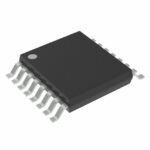 74AVCH4T245QPWRQ1
The activity of extra discounts on wholesale prices is in full swing…
Please fill in your contact information and we will send you the latest wholesale price list.





