 ChipApex | Global Electronic Components Supplier
SEARCH
Search Product
Search Post
— IC芯片 | 连接器 | 传感器 | 被动器件 —
Search productSearch post
— IC芯片 | 连接器 | 传感器 | 被动器件 —
Consult the customer manager about the wholesale price.
consultation hotline:86-132-6715-2157
email:[email protected]
Contact the product manager for consultation. One-stop consultation is available.
Do you want a lower wholesale price? Please send us your inquiry and we will reply immediately.
The 74AVCM162836 is a 20-bit universal bus driver featuring registered outputs with inverted register enable and integrated 15 Ω termination resistors. It operates within a supply voltage range of 1.2 V to 3.6 V, ensuring CMOS low power consumption and input/output tolerance up to 3.6 V. The device provides fast propagation delays, typically ranging from 0.7 ns to 5.2 ns depending on the voltage and signal path. It utilizes a 56-pin TSSOP package with multiple VCC and GND pins for noise reduction.
Verify component authenticity through authorized NXP distributors or certified suppliers. Confirm the specific ordering code matches the required package and temperature range. Check for RoHS compliance status as indicated in official documentation. Ensure storage conditions adhere to specified limits to maintain reliability.
Select this component for high-speed digital interfaces requiring registered buffering with integrated termination. Consider the 1.2 V to 3.6 V operating range for compatibility with various logic families. Evaluate the 56-pin TSSOP footprint against available PCB space. Assess power dissipation requirements based on load capacitance and switching frequency.
This part belongs to the 74AVCM series of low-voltage bus drivers. It is designed to interface between different voltage domains while maintaining signal integrity. The inclusion of an inverted register enable allows for specific control logic configurations in complex digital systems.
Consult official replacement lists for equivalent parts with similar electrical characteristics and pinouts. Verify that any substitute maintains the 15 Ω termination resistance and 20-bit width. Ensure the alternative component supports the same operating voltage range and package type.
The inverted register enable controls the latching of data into the internal registers, allowing for specific timing and control logic configurations in the circuit design.
To ensure a high-impedance state during power transitions, the OE pin should be tied to VCC through a pullup resistor, supporting live insertion capabilities.
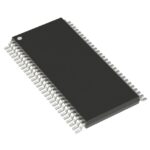 74AVCM162836DGG:11
The activity of extra discounts on wholesale prices is in full swing…
Please fill in your contact information and we will send you the latest wholesale price list.






