 ChipApex | Global Electronic Components Supplier
SEARCH
Search Product
Search Post
— IC芯片 | 连接器 | 传感器 | 被动器件 —
Search productSearch post
— IC芯片 | 连接器 | 传感器 | 被动器件 —
Consult the customer manager about the wholesale price.
consultation hotline:86-132-6715-2157
email:[email protected]
Contact the product manager for consultation. One-stop consultation is available.
Do you want a lower wholesale price? Please send us your inquiry and we will reply immediately.
The onsemi 74F779PC is an 8-bit bidirectional binary counter featuring multiplexed 3-STATE I/O ports, housed in a 16-lead Plastic Dual-In-Line (PDIP) package. It operates within a supply voltage range of +4.5V to +5.5V and supports a maximum clock frequency of 105 MHz at +25°C. The device utilizes two mode pins for control functions including hold, count up, count down, and synchronous load. Propagation delays from the clock to outputs range from 3.0 ns to 11.0 ns depending on conditions.
Verify component authenticity through authorized distributors or direct manufacturer channels. Confirm RoHS compliance status as indicated in official documentation. Check for obsolescence notices or lifecycle changes prior to procurement. Ensure packaging specifications match design requirements. Validate electrical characteristics against current datasheet revisions.
Select this component for designs requiring fully synchronous 8-bit counting with shared I/O lines. Consider the PDIP package for through-hole mounting needs. Evaluate power supply constraints against the specified 4.5V to 5.5V operating range. Assess timing requirements against the documented propagation delay specifications. Verify thermal management capabilities for the intended ambient temperature range.
This part belongs to the 74F series of high-speed Schottky TTL logic devices. It serves as a specialized counter IC designed for applications demanding fast switching speeds and flexible I/O configurations. The device integrates multiple control functions into a single package to reduce board space and complexity.
Check for equivalent parts from other manufacturers offering identical pinouts and electrical characteristics. Verify package compatibility if substituting with surface mount variants. Ensure functional equivalence regarding control logic and output states. Review updated datasheets for any specification changes in potential replacements.
All control functions such as hold, count up, count down, and synchronous load are controlled by two mode pins, S0 and S1.
All state changes are initiated by the rising edge of the clock signal.
Yes, the device features built-in lookahead carry capability to facilitate easy cascading.
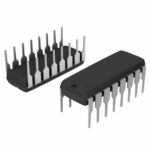 74F779PC
The activity of extra discounts on wholesale prices is in full swing…
Please fill in your contact information and we will send you the latest wholesale price list.





