 ChipApex | Global Electronic Components Supplier
SEARCH
Search Product
Search Post
— IC芯片 | 连接器 | 传感器 | 被动器件 —
Search productSearch post
— IC芯片 | 连接器 | 传感器 | 被动器件 —
Consult the customer manager about the wholesale price.
consultation hotline:86-132-6715-2157
email:[email protected]
Contact the product manager for consultation. One-stop consultation is available.
Do you want a lower wholesale price? Please send us your inquiry and we will reply immediately.
The onsemi 74FST3384QSR is a 10-bit low power bus switch designed for high-speed data routing. It operates within a supply voltage range of 4.0 V to 5.5 V and features CMOS/TTL compatible inputs. The device provides two independent control inputs (OE1, OE2) to manage ten bidirectional switches connecting Bus A to Bus B. Key electrical parameters include a maximum propagation delay of 0.25 ns at 4.5–5.5 V, an on-resistance (RON) typically ranging from 4 Ω to 11 Ω depending on load conditions, and nearly zero standby current. It is housed in a QSOP-24 package.
Verify that the ordering suffix 'QS' corresponds to the QSOP-24 package configuration required for your PCB layout. Confirm RoHS compliance status and Pb-Free designation if environmental regulations apply to your assembly process. Ensure the specific revision level matches your design documentation requirements before finalizing procurement.
Select this component when low insertion loss and high-speed performance are critical for 10-bit parallel data paths. The 4.0 V to 5.5 V operating range makes it suitable for 5 V logic systems. Consider the QSOP-24 package constraints regarding board space and thermal dissipation compared to SOIC or TSSOP alternatives.
This part belongs to the 74FST series of Fast Switch Technology devices, optimized for high-frequency applications. It serves as a direct replacement for similar FST bus switches, offering pin-for-pin compatibility with other manufacturers' equivalents like the QS3384 and CBT3384 within the same functional family.
Public confirmed substitutes include 74FST3384DW, 74FST3384DTR2, and 74FST3384DT. These variants offer identical functionality but differ in packaging (SOIC-24, TSSOP-24). Verify pinout compatibility and thermal characteristics when transitioning between package types.
The device supports input transition rates up to 5 ns/V at VCC = 5.0 V, ensuring compatibility with fast digital signals without distortion.
The device exhibits latchup performance exceeding 500 mA at 85°C, tested according to EIA/JESD78 standards, ensuring robustness against transient currents.
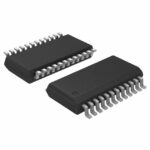 74FST3384QSR
The activity of extra discounts on wholesale prices is in full swing…
Please fill in your contact information and we will send you the latest wholesale price list.






